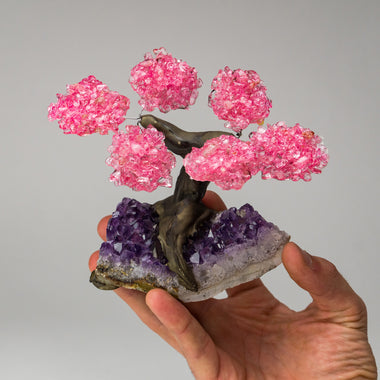
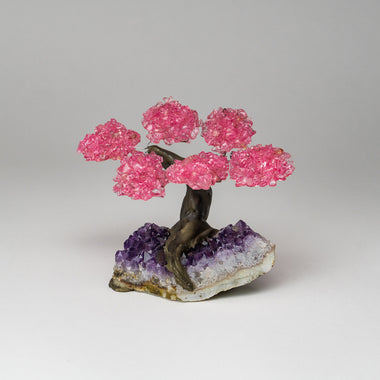
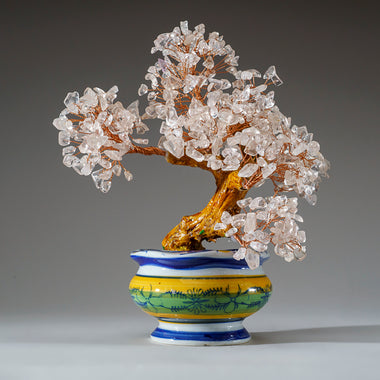
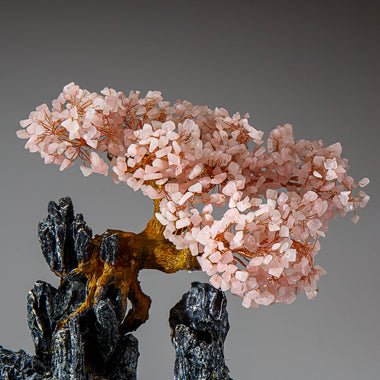
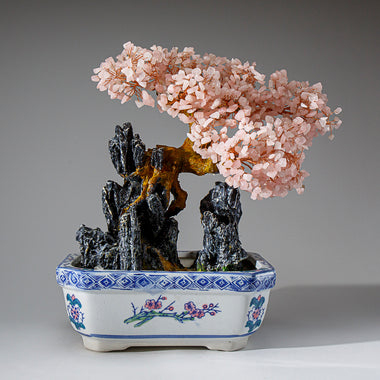
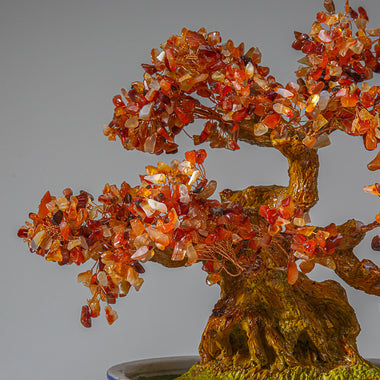
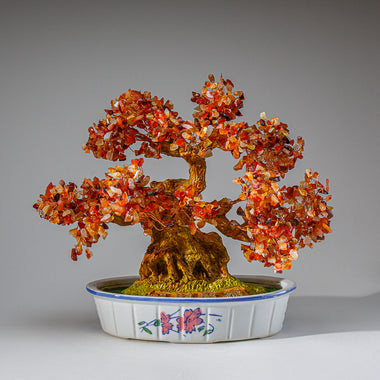
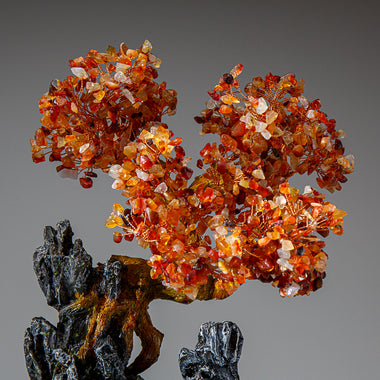
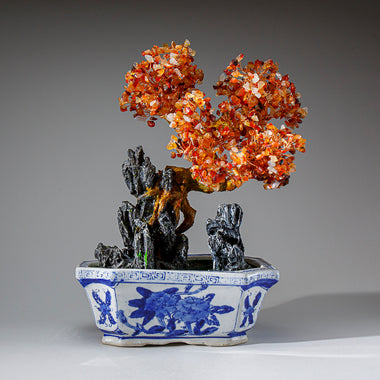
Rose quartz, carnelian, green aventurine and clear quartz chips threaded onto annealed copper in Brazilian workshops.
Gem Trees Wired From Copper and Genuine Stone Chips, Priced by Height, Species and Base
A gem tree is a hand wired sculpture in which polished gemstone chips are threaded onto copper branches, twisted together into a trunk, and seated on a natural crystal matrix or inside a glazed ceramic pot. Astro Gallery of Gems buys these builds direct from the Brazilian workshops that wire them, records species, height in inches and weight in pounds on every listing, and keeps 32 of them in stock across rose quartz, carnelian, green aventurine, clear quartz and mixed gemstone canopies.
Inside the Trunk: Copper Gauge, Twist and Root Spread
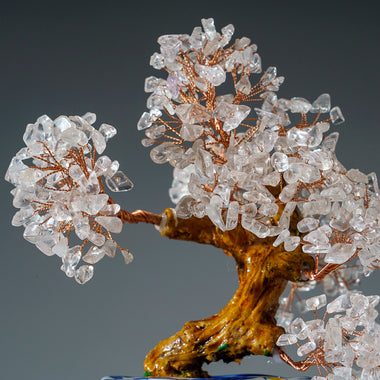
Construction rather than colour decides whether one of these sculptures still holds its shape in five years. Every branch is a single strand of annealed copper running unbroken back into the trunk, where the bundle is twisted into a column and split again into roots.
| Part of the build | What it does and how to judge it |
|---|
| Branch tip wire | Fine annealed copper near twenty six to twenty eight gauge threads through each drilled chip and folds back on itself, thin enough to shape by hand yet stiff enough to hold the angle you set. |
| Trunk bundle and twist | Every branch strand returns into the trunk and the bundle is twisted rather than glued, which is why a sound trunk shows no daylight between its turns. |
| Root spread | Strands fan outward beneath the trunk and grip the matrix or anchor into the pot, and a wide spread lowers the tipping point far more effectively than raw weight does. |
| Base seat and fill | Matrix builds bed those roots down into a crystal cluster, while ceramic pots hold them in a set fill that makes the pot the heaviest single component of a bonsai build. |
| Canopy tie off | Branches are gathered and tied in threes and fives before the final spread, and that grouping is what produces a full crown instead of a thin, gappy one. |
Chip Species Across the Canopies in Stock
Species governs colour, price and the way a canopy answers lamplight. Astro Gallery names the stone in the product title of every build, so the material is settled before a tree is packed.
Brazilian rose quartzPale pink macrocrystalline quartz from Minas Gerais, clouded by microscopic rutile and fluid inclusions. At Mohs 7 the chips survive drilling without spalling, and the soft pink holds indoors and reads warm against oak or walnut.
CarnelianIron stained chalcedony running orange through deep red, a cryptocrystalline quartz that tumbles to a hard glassy finish. Carnelian canopies carry the strongest colour on this page and hold their own against a white or grey wall.
Green aventurineQuartz shot through with flakes of fuchsite mica, which produce aventurescence, a glitter that shifts as somebody walks past the tree. Aventurine chips read green under warm lamps and closer to grey under cold daylight.
Clear quartz and mixed canopiesColourless quartz chips split and scatter lamplight instead of adding colour. Multi gemstone builds run rose quartz, aventurine and carnelian on one frame, giving a crown that changes character with the viewing angle.
Crystal Matrix or Glazed Pot: What Sits Under the Trunk
The base holds the sculpture upright and settles the whole object into a style. Astro Gallery stocks both approaches, and the choice moves weight, footprint and the surfaces a tree can safely occupy.
Natural crystal matrixRoots bed into a genuine amethyst, clear quartz or citrine cluster, so the base is itself a mineral specimen with visible crystal faces. Matrix builds run four to seven inches, weigh roughly one to one and a half pounds, and take the smallest footprint on a working desk.
Hand painted ceramic potRound, oval, square and basket pots hold the roots in a set fill and keep the mass low. Potted builds reach eight and a half to fifteen inches, let a swept bonsai canopy lean well beyond its own base, and stay stable while doing it.
Live Prices Across the Trees in Stock
Height, chip species and base material set each figure, which is why a four inch matrix build and a fifteen inch carnelian bonsai sit so far apart. Every price below reads live from the catalogue, and the tallest bonsai are one of one because no two hand wired canopies spread alike.
Species, height and base named on every listingAstro Gallery measures each canopy across its widest branches and sends that figure before you add to cart.
View all 32 trees
Request photographs
Height, Footprint and the Spot a Tree Will Occupy
Most buyers know the surface before they know the species. Height and canopy spread decide whether a build works on a monitor shelf, a bedside table or a hall console.
| Height tier | Footprint and where it works |
|---|
| Four to five inches | These matrix builds weigh about a pound across the footprint of a saucer, sit beside a keyboard without crowding it, and carry most of the gift buying on this page. |
| Seven to nine inches | Trees in this band run a pound and a half to two pounds and break a long run of horizontal books on a shelf without demanding the full shelf depth. |
| Ten to thirteen inches | Ceramic bonsai weigh two to five pounds with a crown spreading eight or nine inches, which suits a bedside table, an entry console or a dim office corner. |
| Fifteen inches and above | The tallest carnelian and quartz builds need clearance overhead, and they read as the focal point of a side table rather than one object among several. |
Four Points to Check Before You Pay for a Tree
Wire fatigue at the jointCopper work hardens where a branch enters the trunk, and a strand flexed back and forth there will eventually part. Shape a branch once on unboxing, and ask Astro Gallery for a close photograph of that joint beforehand.
Adhesive at the chipGlue belongs under a chip rather than around it. Polished quartz and carnelian read glassy at their edges, so a dried bead of adhesive catches the light and shows plainly in any macro photograph.
Canopy density and balancePhotographed from directly above, a clustered crown fills its circle evenly with no thin quarter. A swept bonsai leans by design, so judge that build against its own overhead image rather than against symmetry.
Base level and glazeSet on a flat surface a matrix build should not rock, and a glazed pot should show no crazing or chipped rim. Astro Gallery notes any glaze fault in the description instead of leaving it to arrival.
Reading the Terms in a Gem Tree Listing
Annealed copperCopper softened by heating so it bends without cracking, which is what allows a canopy to be opened out by hand once the tree is unboxed.
AventurescenceThe glittering sheen inside green aventurine, thrown by flakes of fuchsite mica reflecting light from within the quartz rather than off its polished surface.
Root spreadHow far the wire strands fan out beneath the trunk, since wide roots grip a matrix or a pot fill and give a tall canopy its stability.
Canopy spreadThe width a tree occupies at its widest branches, measured across rather than up, and the figure that settles whether it clears a shelf.
Bonsai sweepA deliberate asymmetric lean wired into a potted build, borrowed from bonsai practice, in which the crown extends past the rim of its pot.
Stock photographA note meaning several near identical builds are held, so a tree matching the species, height and weight shown ships rather than the exact one pictured.
Trees on a Desk, Trees as Gifts, and the Names Buyers Use
Gem trees sell into two intentions. Interior buyers place one as shelf decor or a small focal point where hard geometry needs breaking, searching desk decor and console styling rather than mineralogy. Gift buyers arrive with a date attached, usually a housewarming, an anniversary, a graduation or a gift for a collector, and the named builds carry that message without a card.
Metaphysical and feng shui buyers know the same object as a crystal tree, a wish tree or a money tree, attaching carnelian to drive, rose quartz to the heart chakra and aventurine to a wealth corner. Astro Gallery repeats that vocabulary because buyers type it into a search box, catalogues these builds as handmade decorative sculpture, and attaches no health or energetic claim to them.
Dusting a Canopy and Shaping It Once
Compressed air at low pressure clears a crown faster than any cloth, and a dry cosmetic brush finishes the chips that trap dust in their drill holes. Support the base with one hand whenever a tree moves, because lifting by the crown loads the whole canopy onto the thinnest wire in the build. Rose quartz pales under prolonged direct sunlight and the loss is permanent, so no species here suits a south facing sill. Solvents, aerosol polish and glass cleaner creep beneath the chips and soften the adhesive, so keep every liquid off the branches.
Ordering, Packing and Delivery on a Wired Sculpture
The price on the listing is the price at secure checkout, which settles through Shop Pay, PayPal, Apple Pay or Google Pay, or on a Visa or Mastercard. Astro Gallery issues an itemised invoice naming the species, the height and the base material, and the published returns policy and guarantee both attach to that document. Ask for a particular angle on the canopy before you add to cart, and the images arrive the same working day.
Astro Gallery of Gems has shipped fragile handmade work since 1961 and packs these sculptures to that standard. Tissue immobilises the crown so no branch flexes against its neighbour, the pot or matrix is blocked so the base cannot travel inside the carton, and every tree goes double boxed. Parcels leave tracked and fully insured at declared value, with customs paperwork completed in advance for international addresses and a freight quote agreed first on multi tree orders.
Rated everywhere we trade
Name the surface and the occasionGive Astro Gallery the desk, the shelf or the date and the gallery will shortlist the heights and chip species that fit.
Shop the gem trees
Email the gallery
Questions Buyers Ask Before Ordering a Gem Tree
How much does a gemstone tree cost?
Each build carries its own price on the listing, set by height, chip species and base material. Small four inch matrix trees open the range and the fifteen inch ceramic bonsai close it, and the table above reports every tree in stock right now.
Are the stone chips real gemstone?
Yes. Every canopy is wired from genuine tumbled chips and the species appears in the product title. Rose quartz, carnelian, green aventurine, clear quartz and amethyst all run across the current builds, and any treatment is stated in the description.
What are the branches actually made of?
Solid annealed copper wire, fine at the branch tips and gathered into a twisted bundle at the trunk. Nothing in the frame is moulded or cast, which is precisely why each canopy spreads a little differently.
Which size tree suits a desk?
Choose a four to seven inch matrix build, weighing around a pound and occupying roughly the footprint of a saucer. Anything from ten inches upward wants a bedside table, a console or a shelf with genuine depth behind it.
Do gem trees make a good gift?
Yes, and the smaller matrix builds carry most of the gift buying here because each one arrives ready to display with no assembly. Housewarmings, anniversaries and graduations account for the bulk of those orders.
Can I bend the branches into a different shape?
Yes, once. Annealed copper accepts a single gentle reshaping by hand when the tree comes out of its box, and repeated bending at the trunk joint work hardens the strand until it snaps.
Will I receive the exact tree photographed?
Several builds are held in quantity and marked as stock photographs, so a tree matching that species, height and weight ships instead. Write first and Astro Gallery photographs the individual sculpture being reserved for you.
Can a gem tree be returned?
Yes. The returns policy published on the returns page applies to every tree here. Contact customerservice@astrogallery.com before sending anything back so the return is recorded, and repack the crown in the tissue it arrived in.
Gem Trees Beside the Rest of the Gift Shelf
Buyers reach these sculptures through a species or through an occasion, and the catalogue answers both routes. Follow a chip species into the single species tree pages, or follow the price band into the smaller gift and desk objects.
The same stones in other forms