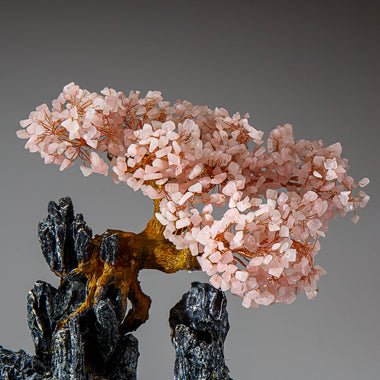
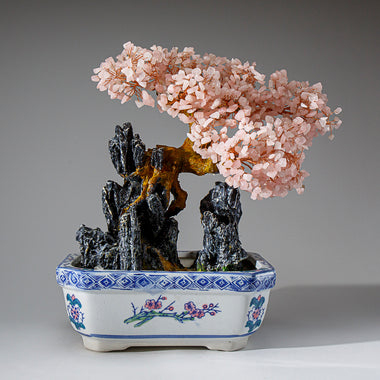
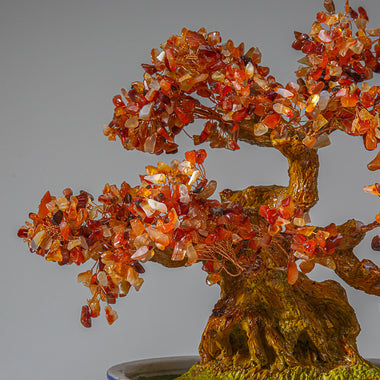
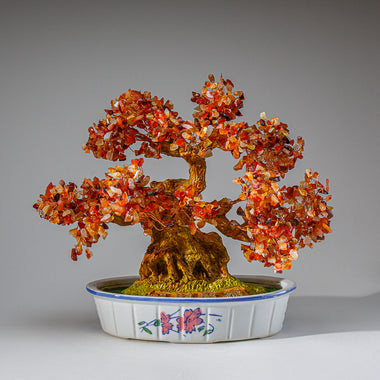
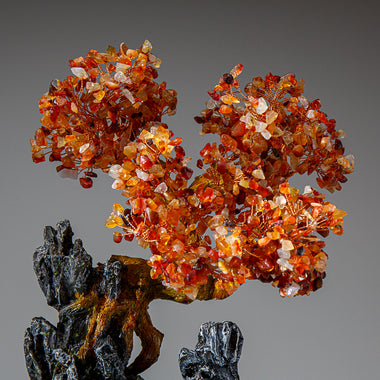
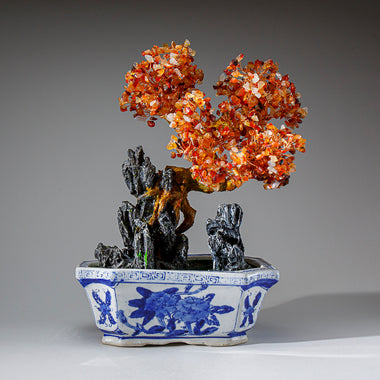
Amethyst chip canopies hand wired in Brazil onto natural crystal matrix, and copper wired bonsai potted in hand painted porcelain.
Buy Amethyst Gemstone Trees, From Five Inch Matrix Builds to Thirteen Inch Bonsai
An amethyst gemstone tree is a wire sculpture whose branches carry polished amethyst chips as leaves, standing either on a natural crystal matrix or in a glazed porcelain pot. Astro Gallery of Gems weighs, measures and photographs each build before it goes online, and the 30 trees gathered here run from a five inch clustered amethyst on clear quartz through to a thirteen inch bonsai, every one hand wired rather than moulded.
Choosing an Amethyst Tree for Your Own Desk or for Someone Else
Buyers arrive at these sculptures from two directions and the two want different builds. A tree bought for your own desk answers to footprint and weight, while a tree bought as a gift answers to the occasion and to the name on the listing, so start from whichever of those questions is genuinely yours.
Keeping it yourselfA five or six inch clustered build occupies roughly the footprint of a saucer and carries enough matrix weight to survive a knocked desk. The Relaxation Tree sets amethyst chips over a clear quartz matrix, which throws the purple forward against a pale base under flat office lighting and keeps its definition on a crowded shelf.
Giving it awayThe named builds carry the message without a card. The Protection Tree runs amethyst chips over an amethyst crystal cluster and stays inside one colour family, which suits a housewarming, while the taller porcelain bonsai read as a considered gift for a graduation, a wedding or a new office.
Judging Amethyst Chip Colour Across These Canopies
Amethyst owes its purple to iron in the quartz lattice combined with natural irradiation, and saturation shifts from one batch of chips to the next. Astro Gallery photographs each canopy under consistent light so grades are compared between listings rather than guessed, since chip colour moves the price here further than height does.
Deep Brazilian purpleThe strongest chips run a saturated violet close to the Rio Grande do Sul and Uruguayan material and hold that colour under weak indoor light. A canopy at this grade reads purple from across a room and sits at the top of the range.
Rose de France and pale lilacLighter chips fall in the pale lilac band the trade names Rose de France. They lose definition against white paint and gain it against dark wood, so the wall behind a tree matters more at this grade than at any other.
Colour zoning inside a chipAmethyst crystallises in colour zones, so a single chip carries a violet tip above a near colourless root. A tumbled canopy mixes those zones together, which produces depth that one flat tone never achieves.
Matched and mixed canopiesSome builds run one species from trunk to tip, others pair amethyst with clear quartz, carnelian, green aventurine or rose quartz beads. Astro Gallery names every species in the product title so the canopy is known before a tree is packed.
How the Trunk, Wire and Base of a Gemstone Tree Are Built
Construction rather than decoration decides how long one of these sculptures holds its shape. Solid copper wire runs from the base through the trunk and out to every branch tip, and the base either grips a natural crystal cluster or seats in a hand painted porcelain pot.
| Build element | What the buyer gets from it |
|---|
| Branch wire gauge | Fine copper strands around twenty six to twenty eight gauge carry the chips, thin enough to open by hand and stiff enough to hold the position afterwards. |
| Trunk construction | Clustered matrix builds use a formed faux trunk over a wire core, while the ceramic bonsai run a hand painted trunk wound from heavier twisted copper. |
| Crystal matrix bases | Natural amethyst or clear quartz clusters, so the base is itself a specimen and the wire roots spread out of sight across the crystal faces. |
| Porcelain pot bases | Hand painted round, square and basket shaped pots, the heavier option and the one that suits a bonsai leaning out beyond its own footprint. |
| Height and weight range | Five inches at about a pound and a half through to thirteen inches at seven and a half pounds, with the tallest canopies spreading nine inches across. |
Checking the Build Before You Pay for an Amethyst Tree
Hand assembly leaves its evidence in four places, and every listing gallery here photographs all of them closely enough to judge. Astro Gallery inspects the same four points before a tree is catalogued.
Trunk wind tightnessCount the strands where the trunk leaves the base. A sound build twists them into one column with no gaps between the turns, while a trunk showing daylight has been wound loose and slackens under handling.
Chip seating and adhesiveAdhesive belongs beneath a chip rather than around it. Amethyst reads glassy at its edges, so dried glue catches light and shows plainly in a macro photograph, as does a chip set off its axis.
Matrix bondWire roots on a matrix build should disappear beneath the amethyst or quartz cluster instead of sitting on top of it. Held by the base and tipped gently, a sound tree gives no movement and no creak.
Canopy balancePhotographed from directly above, a clustered canopy fills its circle without a thin quarter. Porcelain bonsai lean deliberately, so measure a swept build against its own overhead photograph instead of against symmetry.
What Each Amethyst Gemstone Tree Costs Today
Height, chip colour grade and base material set the figure, which is why a five inch matrix build and a thirteen inch porcelain bonsai sit at opposite ends of this range. Every row below carries the live price straight from the catalogue.
Wired, weighed and photographed before listingAstro Gallery records the height, the weight and the base material on every tree and sends further photographs on request.
View all 30 trees
Request photographs
Decoding the Words in a Gemstone Tree Title
ClusteredA canopy built by bunching chips into dense colour pads instead of spacing single stones along the wire. The style gives the fullest crown and dominates the shorter builds here.
MatrixThe natural crystal cluster doing duty as the base. Amethyst matrix keeps a sculpture in one colour, while clear quartz matrix pushes the purple forward against a pale ground.
ChipOne tumbled and polished fragment of gemstone, wired individually to a branch tip. Chip size and colour consistency separate a careful canopy from a quick one.
GaugeWire thickness, counted so a lower number means a thicker strand. Trunks use the heavy end and branch tips the fine end, which is why a trunk holds while a tip bends.
Rose de FranceThe trade name for pale lilac amethyst at the light end of the colour scale, named openly here because the grade suits a dark shelf and vanishes against white paint.
Bonsai buildA tree wired into a swept asymmetric shape and potted in painted porcelain. Round, square and basket pots all appear in stock, and the pot carries most of the weight.
Crystal Tree, Wish Tree and the Words Buyers Search With
One object answers to several names. Interior buyers say gemstone tree or crystal tree and use the form to break a long run of horizontal books or to warm a hall table, while metaphysical sellers say wish tree or money tree and attach amethyst to the crown chakra, to calm and to protection. Feng shui buyers place a tree in a wealth corner and prefer the rounded pots. Naming both registers costs nothing and lets a buyer reach the right build by whichever word they already use.
Astro Gallery sells these as handmade decorative sculptures built from genuine gemstone chips, documents species, height, weight and base material on every listing, and makes no health, healing or energetic claim about any tree here. The two named builds, the Relaxation Tree and the Protection Tree, carry names given by the Brazilian workshop rather than a promise about what a stone will do for anyone.
Dusting and Reshaping an Amethyst Tree
A soft dry brush is the only tool this sculpture needs, worked outward from the trunk so dust leaves the canopy instead of settling deeper into it. Carry a tree by its pot or its matrix and never by the branches, because the weight of the canopy pulls straight against the wire joints. Amethyst pales under months of direct sunlight and does not recover, so keep a build away from a south facing sill. Copper accepts one round of gentle shaping; work the same branch repeatedly and the strand fatigues where it enters the trunk. Water, aerosol polish and cleaning sprays all reach the adhesive, and none of them belongs near it.
How an Amethyst Tree Is Packed and Sent
Orders settle at checkout through Shop Pay, PayPal, Apple Pay and Google Pay, or on a Visa, Mastercard, Discover or Diners Club card, and the invoice names the tree, its height and its weight. Astro Gallery of Gems has shipped fragile handmade work since 1961 and packs these accordingly: the canopy is immobilised in tissue so branches cannot flex in transit, the matrix or pot is blocked against movement, and the whole sculpture travels double boxed. Parcels leave tracked and fully insured at declared value with customs paperwork prepared for international addresses, and the published returns policy attaches to that same invoice.
Rated everywhere we trade
Questions Buyers Ask About Amethyst Gemstone Trees
How much does an amethyst gemstone tree cost?
Each listing carries its own live price, set by height, chip colour grade and base material. Small clustered builds on crystal matrix open the range and the tallest porcelain bonsai close it, and the table above shows the current figure for everything in stock.
Are the amethyst chips genuine stone?
Yes. Every canopy is wired from genuine tumbled amethyst, and the mixed builds use natural undyed quartz, carnelian, green aventurine or rose quartz beside it. The species always appears in the product title.
What sizes do these trees come in?
Current builds run from five inches on a clear quartz matrix at roughly a pound and a half up to thirteen inches in a porcelain pot at seven and a half pounds. Height and weight appear on each listing, so shelf clearance is planned before ordering.
What separates the Relaxation Tree from the Protection Tree?
Both are clustered amethyst canopies made in Brazil. The Relaxation Tree stands on a clear quartz matrix, which lifts the purple against a pale base, while the Protection Tree stands on an amethyst crystal cluster and keeps the whole sculpture inside one colour family.
Will the tree I receive look exactly like the photograph?
Several of these builds are stocked in quantity and marked as stock photographs, so a similar size, weight and quality piece ships. Ask before ordering and Astro Gallery photographs the exact tree being reserved for you.
Can I bend the branches?
Yes. The branches are solid copper and take gentle opening or tightening by hand. Do that once when the tree is unboxed, because the strands fatigue at the trunk joint if they are worked back and forth.
Will amethyst chips fade over time?
Amethyst loses colour under prolonged direct sunlight and the change is permanent. Keep a tree off a south facing windowsill and the chips hold their purple indefinitely under ordinary room light.
Can I return a gemstone tree?
Yes. The returns policy published on the returns page covers every tree. Write to customerservice@astrogallery.com first so the return is logged and the canopy goes back packed the way it arrived.
Browsing On From Amethyst Trees
These sculptures connect to two different parts of the catalogue. Buyers who came for the species follow amethyst into crystals, spheres and carvings, while buyers who came for the form compare canopies across the other chip species wired in the same workshop.