Iron meteorites at Astro Gallery
Buy Iron Meteorites Online — Named Falls, Attributed and Etched
Nothing else on a shelf is 4.5 billion years old. Iron meteorites are core metal from planetesimals that broke apart before Earth finished forming, and the ones that reach a collector have survived a journey no terrestrial rock takes. Astro Gallery has sold meteorites beside minerals and fossils since 1961; 11 irons are in stock now, every one attributed to a named fall or find.
From Planetary Core to Your Shelf: How an Iron Gets Here
Molten metal settles into a coreIn the young solar system, bodies large enough to melt separated into rock and metal. Nickel-iron sank inward and cooled over millions of years — slowly enough for crystals to grow to a scale nothing on Earth reproduces.
A collision shatters the parent bodyImpacts break the body apart and scatter core fragments into orbits of their own, where most drift for aeons before crossing a planet’s path.
Atmospheric entry sculpts the surfaceFriction melts and strips the outer metal, carving thumbprint hollows — regmaglypts — and leaving a dark fusion crust. Sikhote-Alin, seen falling over Siberia in 1947, is the modern textbook case.
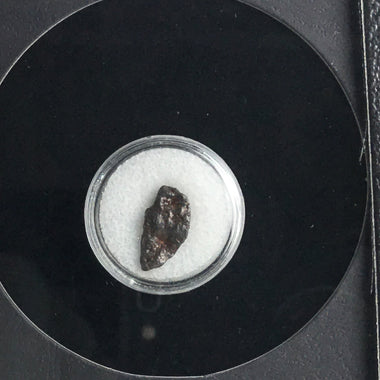
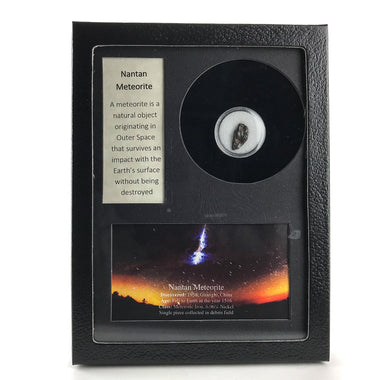
Recovery and attributionThe fall or find gets a name and a documented location: Muonionalusta in Sweden, Campo del Cielo in Argentina, Nantan in China. Without that name, a mass of metal is just a claim.
Cut and etched, or left wholeA dealer either slices and acid-etches the metal to reveal the interior lattice, or leaves the individual intact with its flight skin. Which one you buy is the decision below.
Meteorite Slice or Whole Individual: Which to Buy
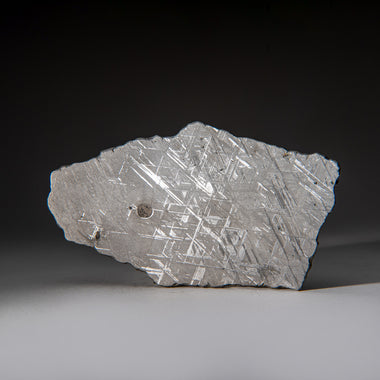
The etched sliceBought for the inside
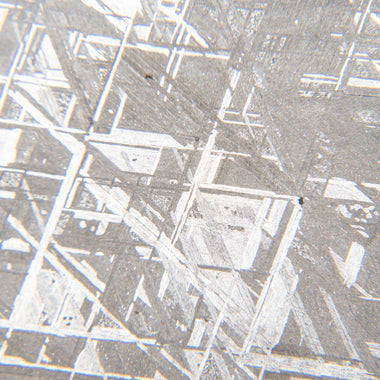
Cutting and etching exposes the Widmanstätten pattern — interlocking nickel-iron bands that took millions of years to grow and cannot be faked at natural scale. It is geometry you can hang.
- Prices by surface area
- Frames and stands easily
- Muonionalusta is the classic etch — 10 listings today
- The proof-of-authenticity buy
The whole individualBought for the outside
An individual keeps what the atmosphere did to it: sculpted hollows, fusion crust, and a density that no photograph conveys. Today’s Campo del Cielo runs to nine pounds.
- Prices by mass and sculpture
- Needs a surface, not a wall
- Campo del Cielo, Sikhote-Alin, Nantan
- The hold-it-in-your-hands buy
Iron Meteorites for Sale — Live Prices
Every meteorite below was weighed and catalogued at the Fifth Avenue gallery before listing. Prices update live; weights are per piece. One decision governs the rest — do you want to see inside the metal, or hold the shape the atmosphere carved?
Every scale, one provenance standard11 attributed irons, priced live — from gram-scale slices to the 86-pound Muonionalusta on its stand.
Shop all irons
Moldavites
Iron Meteorite Value: Attribution, Etch Quality & Mass
AttributionThe named fall or find, stated in the title — the meteorite equivalent of a mineral’s locality line, and the first thing to verify anywhere you buy.
Etch qualityOn slices, high-contrast bands with clean, unbroken geometry are the prize; a muddy or over-etched face flattens the very thing you are paying for.
Sculpture & skinOn individuals, collectors pay for deep regmaglypts, an even surface and preserved fusion crust — the visible record of entry.
Mass & presentationStated weight, plus how it stands. The 86-pound Muonionalusta ships on a custom metal stand because at that scale presentation is part of the object.
Meteorite Terms: Widmanstätten Pattern, Octahedrite, Fall vs Find
Widmanstätten patternInterlocking kamacite and taenite bands revealed by cutting and etching — the iron meteorite’s fingerprint, impossible to forge at natural scale.
OctahedriteThe structural class of most display irons, named for the eight-faced geometry the bands follow.
RegmaglyptsThumbprint hollows melted into the surface during atmospheric flight.
Fusion crustThe dark rind formed as the outer skin melted on entry — prized when preserved.
Fall vs findA fall was witnessed coming down (Sikhote-Alin, 1947); a find was recovered later. Both are named and documented.
Slice vs individualA slice is cut to show the interior; an individual is the stone as it landed.
Iron, Stony or Stony-Iron: Where Irons Sit Among Meteorite Types
Meteorites divide into three families, and knowing which you are buying prevents most disappointment. Stony meteorites — chondrites above all — are the commonest by far: rocky, often unremarkable to the eye, and scientifically the richest, since chondrites preserve the solar system’s original building material. Stony-irons are the rarest and most spectacular, pallasites in particular, where olivine crystals sit suspended in a metal matrix and glow when a slice is backlit. Irons, this collection, are the display default: dense, durable, and the only family that shows the Widmanstätten lattice when cut and etched. Buy an iron for permanence and geometry; browse chondrites or stony-irons when the science or the drama matters more.
Mounting and Displaying an Iron Meteorite
Weight dictates the solution. Small etched slices sit best in an acrylic easel or a shadow box, where a single directional light rakes the pattern and makes the bands read from across a room. Mid-weight individuals want a solid base and a low centre of gravity — sculpture rules apply. Past twenty pounds the piece becomes furniture: the 86-pound Muonionalusta in stock ships on a custom metal stand for exactly that reason. Wherever it lands, keep it away from radiators, humidifiers and open windows; dry air is the entire care regime, and a stable iron needs nothing else for a lifetime.
Iron Meteorite Care, Storage & Purchase Terms
These are solid nickel-iron, and their single enemy is moisture. Keep an iron in a dry room, handle it with dry hands, and in a humid climate add a sealed case or a silica-gel sachet — cheap insurance against the rust freckles that spoil an etched face. Do that and the piece outlives everyone reading this, as it has already outlived the planet’s entire geological surface.
Terms, briefly: postmark a return within fourteen days in its original packing, and a refund clears within two weeks of arrival — or take store credit on the spot. Return postage sits with the buyer; transit damage gets reported the next business day. And if you want to feel the density first, any iron can also be handled at 417 Fifth Avenue, where the same third-generation firm — profiled in Mineralogical Record Vol. 47 No. 4.1 — has traded specimens since 1961.
Rated everywhere we trade
Meteorite FAQs: Authenticity, Price & Magnetism
How do I know these meteorites are real?
Every iron here is attributed to a documented named fall or find — Muonionalusta, Campo del Cielo, Sikhote-Alin, Nantan — and the sliced pieces show the Widmanstätten pattern, a crystal structure that only forms over millions of years inside a planetary core and cannot be reproduced at natural scale. Handle one and the density settles the rest.
Are iron meteorites magnetic?
Strongly — they are solid nickel-iron, and a pocket magnet snaps to them instantly. It is the quickest first check on any claimed iron, alongside density that surprises every first-time holder.
How old is an iron meteorite?
On the order of 4.5 billion years, formed in the cores of the solar system’s first bodies. Nothing native to Earth’s surface approaches that age, which is the quiet reason a small slice makes such an outsized gift.
What is the difference between iron, stony and stony-iron meteorites?
Stony meteorites (chondrites especially) are the commonest and the most scientifically informative; stony-irons like pallasites are the rarest, with olivine suspended in metal; irons are dense display metal and the only family that shows the Widmanstätten pattern when cut and etched.
What does an iron meteorite cost?
Price follows named fall, mass, form and presentation: small attributed slices are an accessible entry, large etched slices climb with surface area, and one-off display pieces are priced as centrepieces. All prices are live on the listings.
How should I mount an iron meteorite?
Slices suit an acrylic easel or shadow box with one directional light raking the etch. Individuals want a solid base and a low centre of gravity, and heavy pieces ship on purpose-made stands. Keep any iron away from humidity sources.
Will an iron meteorite rust?
It can, if kept damp. In a dry room, handled with dry hands, an iron stays stable indefinitely; in humid climates a sealed case or silica-gel sachet solves it.
Can I hold one before buying?
Yes — and you should; photographs never convey the weight. Ask for the pieces you want at 417 Fifth Avenue: (212) 889-9000.
Meteorites in the Specimen Catalogue
The meteorite wing stands beside the fossil and mineral halls: three sciences, one specimen standard. Irons anchor it — dense, permanent, displayable — and it extends to moldavites, the green impact glass thrown from a single Central European strike.