Skip to content

Spheres

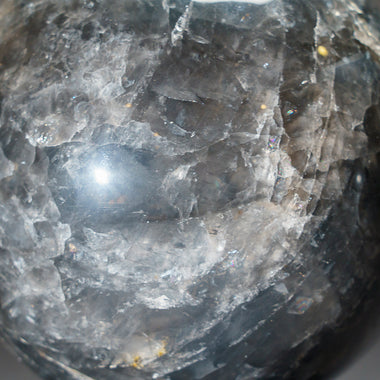
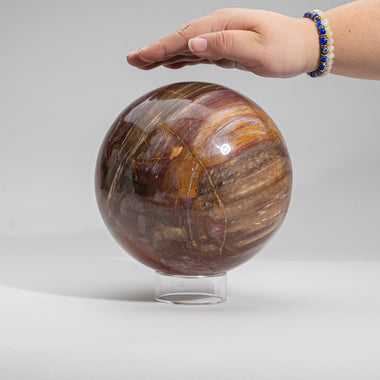
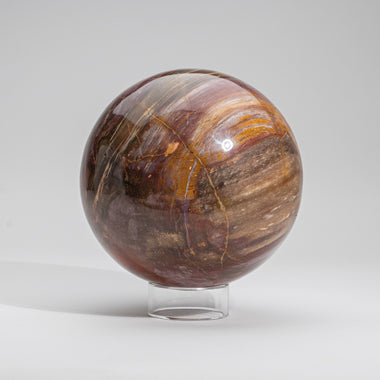
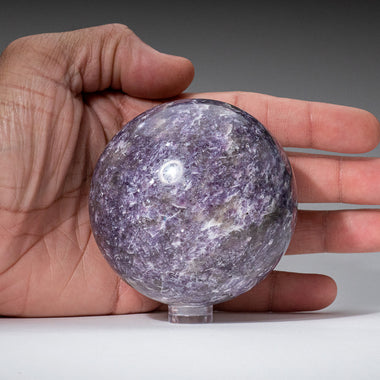
Malachite from Katanga, petrified wood and strawberry quartz from Madagascar, smoky and blue quartz from Brazil, banded aragonite from Morocco.

Polished Stone Spheres Turned One at a Time, With Species, Diameter and Live Price on Every Listing

A stone sphere is one block of mineral turned on a lapidary machine until every line drawn through its centre measures the same, which is why a sphere shows its species from all sides rather than from one chosen face. Astro Gallery of Gems buys sphere rough in Katanga, Madagascar, Brazil, Morocco and Peru, weighs and measures each finished ball, then photographs it beside the stand it ships with, so all 81 spheres here carry their own diameter, weight and pattern.

Turning a Sphere: Sawn Cube, Cup Grinder, Cerium Polish

A sphere is the most demanding form a lapidary cuts, because a flat panel can hide a shortcut and a continuous curve advertises one. The maker sacrifices close to half the block before the first true curve appears. Each stage below removes material that nobody can put back, which is what a finished price pays for.

Stage on the machineWhat that stage settles for the buyer
Sawn cubeThe cutter saws a cube and decides at that moment which banding, orb or flash will cross the equator of the finished ball.
Knocking the cornersCorners come off against a diamond wheel, and any fracture hidden inside the rough reveals itself here rather than after the polish.
Cup grindingRotating cups spin the piece against its own axis until it runs round within a fraction of a millimetre, which decides whether a ball rocks or rolls.
Diamond sanding sequenceFiner diamond grits erase the scratches left by the grit before them, and skipping one step leaves a haze that no final polish will lift.
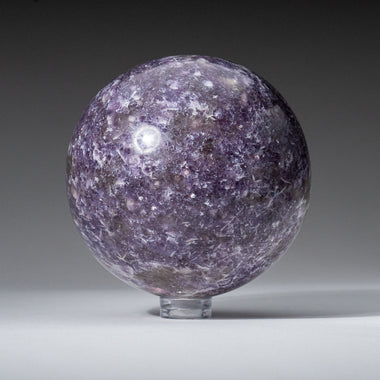
Cerium oxide polishCerium oxide on a soft pad brings the surface to a mirror, and raking light then returns one unbroken reflection from pole to pole.

Which Species Take a Sphere, and Where That Rough Is Mined

Hardness, grain and density decide which minerals survive the cup grinder, while the deposit decides how large a ball the material can yield. Astro Gallery selects rough from a sawn face where the pattern already shows.

Katanga malachiteMalachite from the Kolwezi mines of the Democratic Republic of Congo turns into concentric green bullseyes that wrap the whole ball. This copper carbonate carries a specific gravity near four, so the heaviest examples approach seventeen pounds.
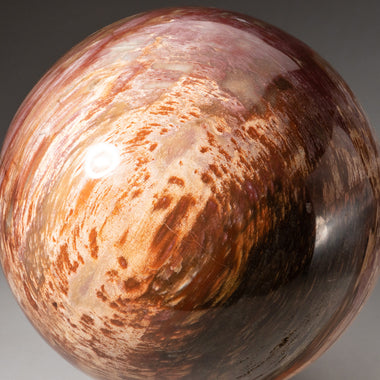
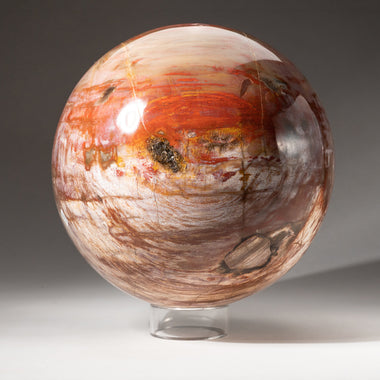
Madagascan petrified woodPetrified wood from Madagascar records tree cells replaced by silicon dioxide, and turning it cuts that fossil grain in every direction at once. The material reaches Mohs 7 and arrives in wide logs, so these spheres pass eight inches.
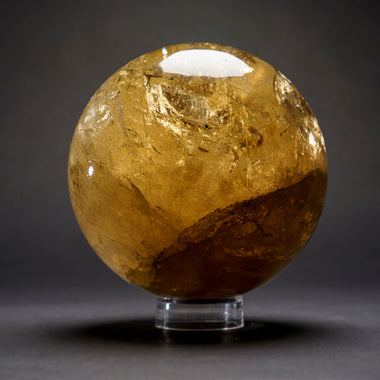
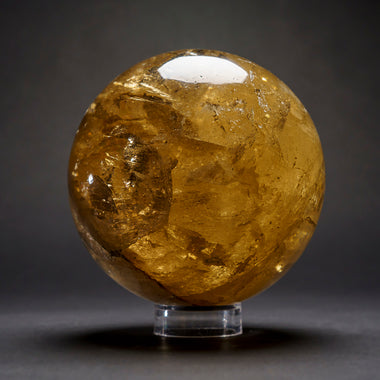
Brazilian smoky and blue quartzBrazil supplies the transparent quartz here. Smoky quartz takes its colour from natural irradiation of aluminium centres, blue quartz from light scattering inside the structure, and both sit at Mohs 7 and hold a hard mirror.
Moroccan aragonite and Peruvian rhodoniteMorocco sends banded aragonite, a calcium carbonate polymorph whose lattice differs from calcite and which stripes brown, tan and white. Peru sends rhodonite, a manganese silicate whose pink fields carry black manganese oxide veining.

Reading Diameter and Weight Before You Commit to a Sphere

Diameter and weightWhat sits in that tier and where it goes
Two to three inches, one to three poundsLabradorite from Madagascar and rhodonite from Peru fill the entry tier, which carries most of the gift buying and groups well in threes on a desk.
Three to four inches, three to seven poundsOcean jasper, banded aragonite and Brazilian smoky quartz occupy this range, which suits a bookshelf and still lifts in one hand.
Six to seven inches, thirteen to eighteen poundsBlue quartz, rose quartz and strawberry quartz balls anchor a console at this diameter and need a clear sight line to read.
Eight inches and above, past thirty poundsLarge petrified wood and malachite spheres concentrate their whole mass on one contact point and require a surface rated for that load.

What Every Sphere in Stock Costs Today

Each row names one physical ball, photographed as it will arrive and priced against its own weight, diameter and finish. Astro Gallery prices these spheres at gallery rate inside the catalogue, and the row for any ball vanishes at the moment it is sold.

PieceDetailPrice
Genuine Polished Malachite Sphere (1.4 lbs) 1.4 lbs $ 630.00
Genuine Polished Large Malachite Sphere (16.8 lbs) 16.8 lbs $ 4,500.00
Genuine Polished Large Malachite Sphere (16.5 lbs) 16.5 lbs $ 4,200.00
Genuine Large Polished Petrified Wood Sphere from Madagascar (8.5", 31.5 lbs) 8.5", 31.5 lbs $ 4,500.00
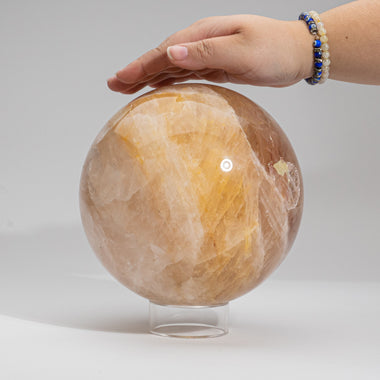
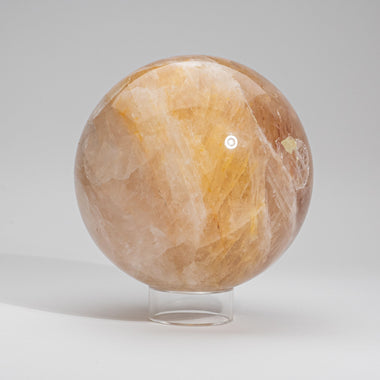
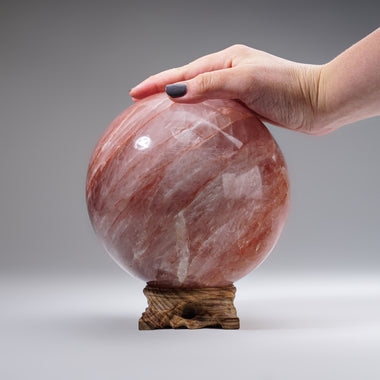
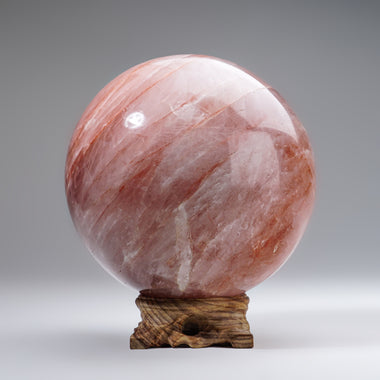
Polished Rose Quartz Sphere from Madagascar (6.75" Diameter, 17.2 lbs) 6.75" Diameter, 17.2 lbs $ 4,750.00
Polished Strawberry Quartz Sphere from Madagascar (14.7 lbs) 14.7 lbs $ 1,500.00
One ball, one photograph, one priceEvery sphere here came off a separate block, so the diameter, weight and pattern in the images belong to the piece you receive.
View all 81 pieces Request photographs

Pinholes, Orange Peel and Out of Round: Finish Checks Before Payment

Four faults account for most disappointment with a polished sphere, and each shows in a photograph taken under raking light. Astro Gallery photographs the equator and both poles of every ball so these checks happen before payment.

RoundnessSet a sphere on a level surface and watch it settle. A ball turned out of round rests in one position, rocks when you nudge it, and throws an elliptical highlight where a lamp reflects.
Pinholes and vugsPinholes are gas or crystal cavities that grinding opens at the surface, and petrified wood, ocean jasper and aragonite carry them naturally. Astro Gallery describes them on the listing, because a filled pinhole is a repair.
Orange peelSofter and harder zones inside one ball abrade at different rates, leaving a dimpled texture that appears only under a low angled light. Malachite and rhodonite show it first, because their hardness shifts band to band.
Dye and stabilisationNatural colour runs through the stone and reaches the floor of every pinhole, whereas dye concentrates in cracks and pales at a chipped edge. Any fill or repair appears in the description before you buy.

The Ring Stand and the Ball: Two Ways a Sphere Sits

Spheres supplied on an acrylic ring standAn acrylic ring lifts the ball clear of the shelf, keeps the polish off dust and lets you turn a chosen face towards the room. Astro Gallery includes a ring of that kind with the malachite, blue quartz and smaller quartz balls at no separate charge.
Spheres that seat in a cradle or on the shelfHeavy petrified wood and large rose quartz balls carry enough mass to rest in a shallow turned cradle or straight on a felt pad. That arrangement lowers the centre of gravity, suits open shelving and removes the visual break a stand introduces.

Six Terms That Describe a Turned Sphere

Out of roundA sphere whose diameters differ measurably, which a buyer detects when the ball settles into one resting position instead of rolling freely.
PinholeA small natural cavity opened at the surface during grinding, common in petrified wood and jasper, and disclosed on the listing rather than filled.
Orange peelA gently undulating polish caused by zones of differing hardness sanding unevenly, visible only when light travels across the ball at a low angle.
VugAn open crystal lined pocket exposed by the cut, which the lapidary leaves unpolished so the crystal faces inside keep their natural lustre.
Specific gravityThe density of a mineral against water, which explains why malachite at close to four feels far heavier than quartz of identical diameter.
Ring standA moulded acrylic ring that seats a sphere at a fixed angle, supplied with the pieces here that will not sit unaided.

Placing a Sphere at Home, and the Names Buyers Give It

Interior buyers reach for a sphere because it is the one form in a room with no direction, so a single ball settles a shelf of vertical spines and three graded diameters read as a composition. Designers set the heaviest sphere at eye level on a console and keep a lamp to one side, so the polish reads as depth rather than glare.

Metaphysical buyers arrive at these objects through other words, asking for a crystal ball, a scrying sphere or a grounding stone, and choosing rose quartz for the heart chakra, smoky quartz for grounding and malachite for protection. Astro Gallery records that vocabulary because buyers search with it, documents species, locality and weight on each listing, and makes no health or energetic claim.

Keeping a Turned Sphere Free of Marks

Malachite governs sphere care, because it is the softest and most reactive material turned in this collection. Copper carbonate at Mohs 3.5 to 4 scratches under a fingernail and etches on contact with acid, so dust it dry and keep vinegar, glass cleaner and standing water away permanently. Banded aragonite and rhodonite want the same treatment. Quartz, petrified wood and jasper accept a damp cloth and a dry buff, though rose quartz and strawberry quartz lose colour under months of direct window light. Every sphere rolls once knocked, so seat each one in its ring or a felt cradle.

Paying for a Sphere and Getting It to Your Door

Checkout takes the figure shown on the listing and nothing beyond it, settling through Shop Pay, PayPal, Apple Pay, Google Pay or a Visa, Mastercard, Discover or Diners Club card against an itemised invoice. Ask us beforehand for the exact diameter in inches, a close photograph of the equator, or a short clip of a lamp travelling across the polish, and our team sends those the same working day.

Astro Gallery of Gems has packed mineral objects out of its New York gallery since 1961, and a sphere gets packed as a rolling weight rather than a static one. We seat each ball in cut foam so no pressure lands on one contact point, box the acrylic ring apart from the stone, and build a second carton around anything past a pound. Tracking and full insurance cover the journey to any country, and the customs declaration travels with the parcel. Spheres beyond roughly twenty pounds ship on a freight quote agreed with you in advance, and the guarantee published on about us, together with our returns policy, governs every stage.

Rated everywhere we trade

Ask for the equator before you buyRequest the pole, the equator and the base of any sphere photographed under raking light, and we will send those images the same working day.
Browse the spheres Email the gallery

Sizing, Stands, Shipping: Eight Answers Before Checkout

How much does a polished stone sphere cost?
Small labradorite and rhodonite balls open the range, mid weight jasper and aragonite spheres occupy the middle, and large malachite, rose quartz and petrified wood spheres sit at the top. Each figure in the table above comes straight from the catalogue and belongs to one ball rather than to a size bracket.
Does the sphere come with a display stand?
Many spheres here ship with an acrylic ring stand included in the listed price, and the description says so on each product page. Heavier balls seat on a felt pad or a turned cradle instead, and we confirm which arrangement applies before you order.
Is the sphere solid natural stone?
Yes. Each sphere was turned from one solid piece of natural material with no reconstitution and no resin core, and any stabilisation appears in the description. Astro Gallery states the species and the country of origin on every listing.
What diameter suits a desk or a console?
Two to three inch balls at one to three pounds work on a desk and group well in odd numbers. Six to seven inch spheres at thirteen to eighteen pounds anchor a console, and anything above eight inches needs a surface rated for concentrated weight.
Why does a polished sphere show tiny pinholes?
Pinholes are natural cavities that the grinding wheel opens at the surface, and they occur most often in petrified wood, ocean jasper and aragonite. Astro Gallery photographs them rather than filling them, because a filled pinhole counts as a repair.
Will I receive the exact sphere in the photographs?
Yes. Each ball comes off a separate block and is photographed individually, so the banding, orbs or flash you study are the ones that arrive. The stated diameter and weight belong to that piece.
How do I clean a malachite sphere without damaging it?
Use a dry microfibre cloth and nothing wet at all. Copper carbonate at Mohs 3.5 to 4 surrenders its shine to acid, so a cleaning spray, a splash of vinegar or water left sitting on the curve will etch the surface beyond recovery.
Do you ship heavy spheres internationally, and can I return one?
Yes to both. Tracking and full insurance cover every destination, the customs declaration is completed before dispatch, and balls beyond twenty pounds move on a freight quote agreed with you. The returns page states what applies if a sphere has to come back.

Spheres Beside the Other Turned and Polished Forms