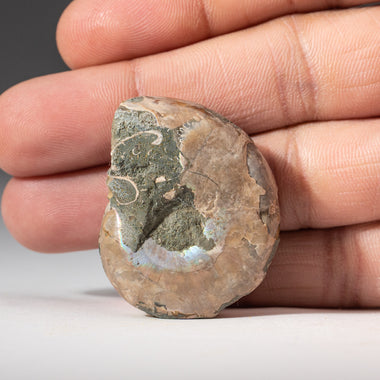
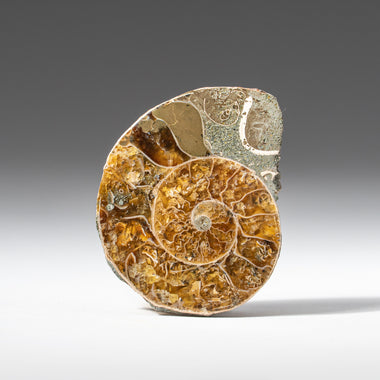
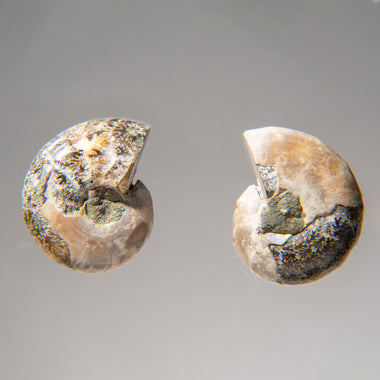
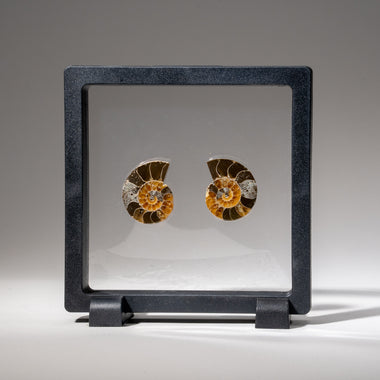
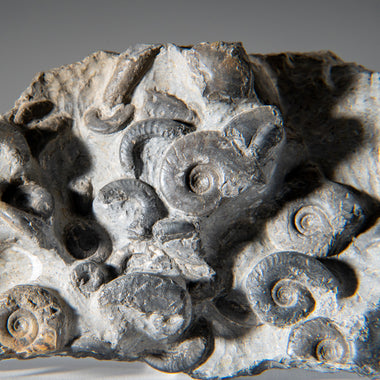
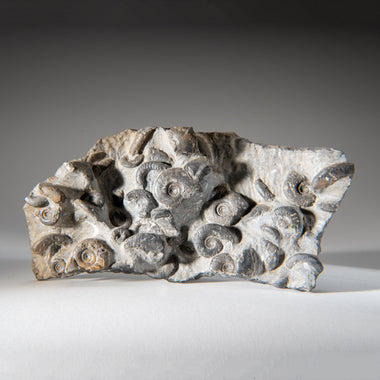
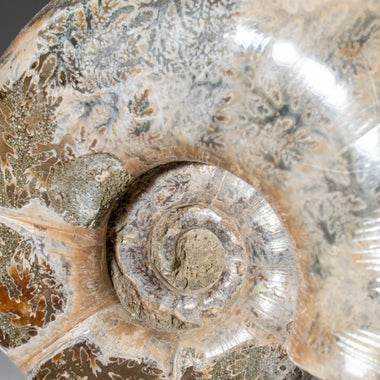
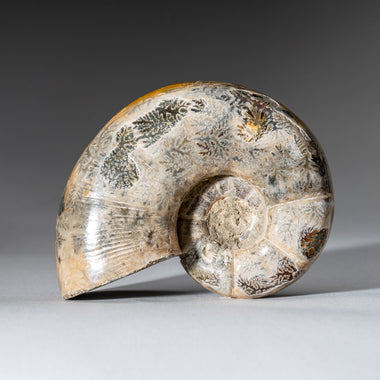
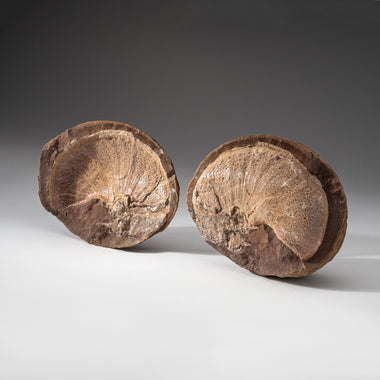
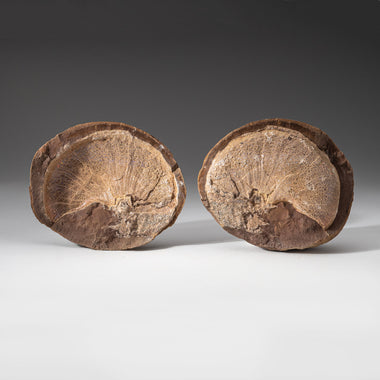
Calcite lined halves and matched pairs from Madagascar, Lower Jurassic Promicroceras clusters, and shells carrying opalescent nacre.
Buy Ammonite Fossils by Species, Age and Preparation
An ammonite is the coiled external shell of an extinct marine cephalopod, divided internally by septa into gas filled chambers and preserved when mineral replaced the original aragonite. Buy from the 6 ammonites catalogued on this page and each shell carries a stated geological age, a country of origin, and the preparation it received on the bench before listing. Astro Gallery of Gems takes ammonite material directly from the collectors working the Madagascan and Moroccan beds, has it prepared under magnification, and writes any restoration into the description instead of leaving a buyer to discover it.
Species, Age and the Beds They Came Out Of
Ammonites ran from roughly 240 million years ago to the close of the Cretaceous, and where a shell sat in that span shapes its ornament, its size and its price. The four groups below account for what reaches this page.
Mahajanga Basin, MadagascarCretaceous marls in the Berivotra country supply the sawn and lapped halves stocked here, listed at roughly seventy to seventy five million years. Calcite has replaced the shell internally while patches of original mother of pearl survive on the outer whorl.
Promicroceras marstonense clustersLower Jurassic limestone around two hundred million years old, carrying dozens of small coiled shells on one bedding plane. Every ammonite on the face is freed individually with pneumatic tools, which is why a prepared cluster costs many times its raw weight.
Erfoud and Rissani, MoroccoAnti-Atlas quarries yield shells locked in dense black limestone, worked into standing specimens and polished plates. Moroccan material takes a high finish and shows suture detail well, and it also carries the highest rate of composite work in the trade.
Opalescent and pyritised shellsSurviving nacre throws pink, purple and green iridescence across an Upper Cretaceous shell, while iron sulphide replacement gives smaller Jurassic ammonites a metallic gold surface. Both preservations price well above plain calcified material of the same diameter.
Preservation Sets the Price Before Diameter Does
Two ammonites of identical width can sit a long way apart on price, and preservation explains almost all of that gap. Astro Gallery grades incoming shells by what replaced the aragonite first and by size second.
| Preservation | What it shows and what it means for the buyer |
|---|
| Calcite replacement | Aragonite dissolved and regrown as calcite, so a sawn half opens onto chambers lined with clear crystal. This is the commonest and least expensive preservation on the page and the easiest to display. |
| Surviving nacre | Patches of the original shell layer survive on the outer whorl, throwing an opalescent sheen that shifts as the viewer moves. These edges chip easily, and the preservation prices above calcified material of the same diameter. |
| Pyrite replacement | Iron sulphide stands in for shell, giving small Jurassic ammonites a gold metallic surface. These shells run dense for their size, catch a lamp well, and demand dry storage for the life of the specimen. |
| Shell and matrix, positive and negative | The shell parts from its natural mould so both faces display together on stands. This preservation teaches best, survives recovery least often, and holds the top of this range. |
Shop Ammonites at the Figures Showing Now
Each line below is a single catalogued specimen with its own weight and dimensions. Figures update from stock as pieces move, so a shell that sells clears out of the table rather than sitting there as something no buyer can add to the cart.
Sutures, Ribbing and the Keel Identify a Shell
Where each internal septum met the outer wall it left a fluted line, and that suture is the single most reliable identifier a fossil ammonite carries. Simple zigzag goniatitic sutures mark the oldest Palaeozoic forms, ceratitic sutures with frilled valleys follow in the Triassic, and the fern like ammonitic sutures of the Jurassic and Cretaceous divide and subdivide across the whorl. Rib count, rib branching, the presence or absence of a raised keel along the outer edge, and the width of the umbilicus complete the picture. A description that names a genus without showing sutures or ribbing is describing a shape rather than a species.
Preparation and Restoration Declared Before You Buy
Almost every ammonite offered anywhere has been worked on, and the honest question is which work and how much. These four points cover what separates a prepared specimen from a rebuilt one.
How the matrix came offAir abrasive and pneumatic scribe work under magnification follows the ribbing and leaves the ornament intact. Astro Gallery records which method a shell received, since acid preparation strips fine detail that never returns.
Fill, paint and composite workComposites assembled from two shells and painted fills circulate widely in the Moroccan trade. Astro Gallery checks incoming ammonites under long wave ultraviolet, where modern resin fluoresces and original shell does not.
Where the saw went throughA cut half should show a clean plane through the centre of the coil and a lapped face without ridges. An off centre cut truncates the inner whorls and destroys the chamber pattern buyers came for.
Nacre stabilityIridescent shell layers lift and flake as they dry out. Astro Gallery states any consolidant applied to a nacreous specimen, so a shell stabilised with Paraloid resin is never offered as untouched.
Order a Polished Half, a Matched Pair or a Full Round Shell
Buyers split cleanly into two camps here, and the split has more to do with what a specimen is for than with what it costs. Astro Gallery prices both routes on preservation and preparation rather than on diameter alone.
Halves, pairs and boxed setsA shell sawn through the coil and lapped so the calcite chambers show, sold singly or as a matching pair cut from one specimen. Pairs open like a book, sit in a lidded display box, and carry the entry pricing here, which is why classrooms and gift buyers take most of them.
Full round shells and matrix platesAn uncut specimen holding its ribbing, keel and umbilicus, or a shell separated from its natural mould so both faces stand together. These cost more for their weight, need an acrylic stand or their original rock, and hold the value a serious collector is paying for.
Terms an Ammonite Description Uses
SeptumThe dividing wall between two chambers. Where a septum meets the outer shell wall it draws the suture line used to identify the genus.
Suture lineThe fluted trace of a septum against the shell wall, ranging from simple goniatitic zigzags to the branching ammonitic patterns of later species.
PhragmoconeThe chambered, buoyancy regulating portion of the shell, distinct from the open body chamber at the mouth where the animal itself lived.
SiphuncleThe narrow tube threading through every septum, visible as a small circle on a lapped face, through which the animal moved gas and liquid.
UmbilicusThe depression at the centre of the coil. Its width against total shell diameter is one of the first measurements used to separate genera.
PseudomorphA fossil whose original aragonite has been swapped mineral for mineral by calcite or pyrite while the outward form survives unchanged.
Display, Teaching and Gifting a Fossil Shell
An ammonite works harder in a room than most fossils because the spiral reads from any angle. Interior buyers stand a lapped half on a stack of books or hang a large matrix plate as wall relief, and a pair placed with the cut faces outward doubles the pattern across a console. Teachers and parents buy the small boxed pairs by the handful, since a chambered half explains buoyancy, extinction and deep time faster than a diagram does. Collectors chase genus, locality and the quality of the preparation instead.
The spiral also carries a long metaphysical and feng shui vocabulary, described as a stone of change, of prosperity or of grounding, and buyers arrive using those words. Astro Gallery documents species, age, locality, weight and preparation on each ammonite and makes no health, healing or energetic claim about any specimen.
Pyrite Decay, Damp and Keeping a Shell Stable
Fossil shells fail from humidity rather than handling. Pyritised ammonites oxidise in damp air, producing iron sulphate and sulphuric acid that swell, crack and eventually powder a specimen, so keep those pieces below roughly fifty percent relative humidity and add a silica gel sachet to a closed display case. Nacreous shells lose iridescence when they dry too fast or sit in direct sun, and they should never be washed. Dust every ammonite with a dry soft brush along the ribbing, and keep water, ultrasonic tanks and household sprays away from calcite chambers and consolidated shell alike. Support a heavy matrix plate along its full length, because these split on the bedding plane if they flex.
Paying for a Fossil and How It Reaches You
Checkout settles through Shop Pay, PayPal, Apple Pay, Google Pay or a Visa, Mastercard, Discover or Diners Club card, and the listed figure is what the card is charged. Astro Gallery of Gems has sold fossils under its own invoice since 1961, and that itemised invoice names the species where identified, the age, the locality, the weight and any restoration. Specimens are wrapped so no pressure reaches an exposed suture face, blocked into a fitted carton, and double boxed above a pound, then sent tracked and insured with import paperwork attached. The returns policy and the guarantee on about us cover each of those steps.
Rated everywhere we trade
See the sutures and the saw line firstAsk for close photographs of the lapped face, the outer whorl and any repair, and we will send them before you order.
Browse the ammonites
Email the gallery
Ammonite Questions Answered Before Purchase
How old are these ammonites?
The Madagascan halves are listed at roughly seventy to seventy five million years, placing them in the Late Cretaceous, while the Promicroceras clusters are Lower Jurassic at about two hundred million years. Every listing states the age for that specimen rather than a range for the collection.
How much does an ammonite fossil cost?
Small calcified halves and boxed pairs open the range, mid sized calcified and nacreous shells occupy the middle, and prepared clusters and matrix specimens sit at the top. The table above carries the live figure for each piece in stock, so you buy at that specimen's own price.
Are these genuine fossils rather than reproductions?
Every ammonite here is a genuine fossil shell, not a cast or a resin copy. A certificate of authenticity travels with the specimens whose listings state one, and we will confirm in writing for any piece before you order it.
Has the specimen been repaired or restored?
Where repair, fill or consolidant has been applied, the description says so. We inspect incoming shells under long wave ultraviolet, decline composites assembled from more than one animal, and photograph any repair on request.
Where do your ammonites come from?
Chiefly the Cretaceous beds of the Mahajanga Basin in Madagascar and the Anti-Atlas quarries around Erfoud and Rissani in Morocco, with Lower Jurassic clusters from limestone beds. The source country appears on each listing.
Will I receive the exact fossil in the photograph?
For clusters, matrix specimens and larger shells, yes, since each is photographed individually. Small repeat halves and boxed pairs are marked as stock photographs, and those ship as a specimen of matching size, age and quality.
How should I clean and store an ammonite?
Brush it dry along the ribbing with a soft brush and keep it away from water entirely. Pyritised shells need air below about fifty percent humidity, so a silica gel sachet in a closed case protects them for years.
Do you ship ammonites overseas, and what happens if one arrives damaged?
Every ammonite order travels worldwide, tracked and insured to the invoiced value, with import documentation completed before the parcel leaves. Photograph the carton and the specimen on arrival and contact us the same day, and the insurance and our returns terms resolve it.
Ammonites Beside the Rest of the Natural History Catalogue
Ammonites sit inside a much wider fossil catalogue, so the deciding question is whether the spiral itself or the deep time story matters more to you. Collectors following cephalopods move across to other marine material, while buyers wanting age alone find it in teeth, wood and meteorite iron.
Minerals inside these shells