Wire, chips and a base: how these are made
Buy Gemstone Trees Online: Handmade Bonsai and Willow Forms on Ceramic Pots and Mineral Bases
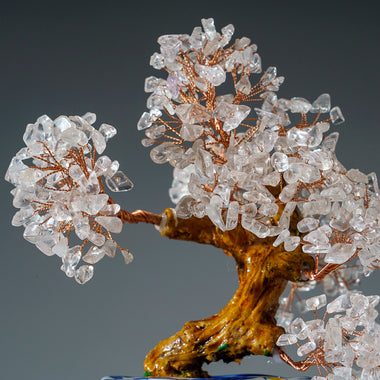
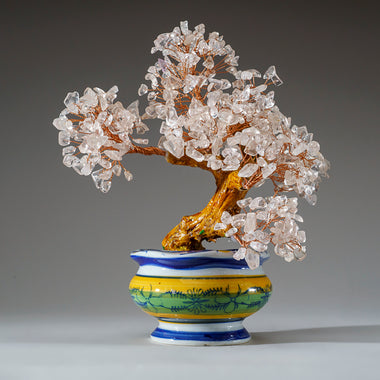
A gemstone tree is a hand assembled sculpture in which hundreds of small polished stone chips are threaded onto fine wire, twisted into branches, gathered into a trunk and seated in a ceramic pot or on a natural mineral base. Nothing about it is moulded or cast. Astro Gallery of Gems has 34 gemstone trees live here in amethyst, carnelian and garnet, at nine, twelve and fifteen inches, from under fifty dollars for a small pot tree to a four figure custom built cluster tree on an amethyst matrix. Because no two hand made trees come out identical, each one is listed and photographed as itself, which is why two amethyst bonsai of the same height can carry different prices.
This page is the hub for the whole range: construction, form, sizing and how to tell a well built tree from a cheap one, whichever stone you choose. If you already know you want purple, the amethyst gemstone trees collection is the dedicated page for that stone and handles the colour question properly. Everything below applies across the range.
How a Gemstone Tree Is Actually Built
Understanding the build is the fastest way to judge quality, because every shortcut leaves a visible trace. A tree is assembled from the leaf inward, not from the trunk outward, and the sequence never changes.
The wire comes firstFine annealed wire is cut to equal lengths. Annealed means heat softened, so it bends smoothly and holds a shape instead of springing back or snapping at the fold. Cheap trees use hard wire and the branches ping back when moved.
Chips are graded before they are strungPolished chips are sorted by size and translucency, then threaded on or wrapped in place. A careful maker grades down toward the tips so the canopy tapers. An indifferent one uses whatever comes out of the bag.
Small groups become branchletsThree to six strands are twisted into a branchlet, then several branchlets are twisted into a branch. This is where the labour sits, and counting the visible junctions on a finished tree is effectively counting hours.
The branches are gathered into a trunkAll the branch wires are brought together and twisted, sometimes bound with a second wrapping wire for thickness. A good trunk tapers upward and shows a spiral grain; a poor one is a straight bundle with a visible kink.
The trunk is seatedThe wire ends are splayed into roots and set into a ceramic pot with a hard filler, or spread across a mineral base so the tree grips the rock. This joint carries the entire weight and is where a badly made tree fails first.
The canopy is opened by handLast, the maker opens the branches outward until the tree stands square without leaning and the canopy reads as a rounded mass rather than a flat fan. This step is what separates a sculpture from a bundle of wire.
Wire, Chip and Armature: The Terms Defined
ArmatureThe wire skeleton underneath the stone. Posture, spread and stability are all decided by the armature rather than by the chips hung on it.
Annealed wireWire heat softened so it bends without work hardening. It takes a curve and keeps it, which is what lets branches be reshaped years later without snapping.
ChipA small tumbled or drilled fragment of polished stone used as a leaf. Chip size, translucency and consistency separate price tiers within the same stone.
Wire gaugeThe thickness number of the wire, where a lower number means thicker metal. Trunks use heavier gauge than tips, and a tree built from one gauge throughout tends to droop.
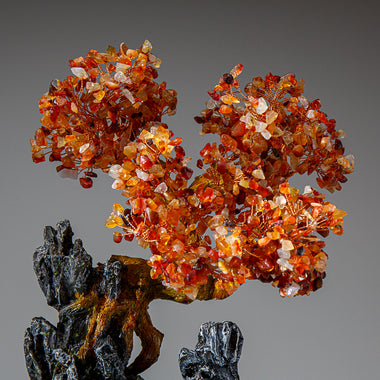
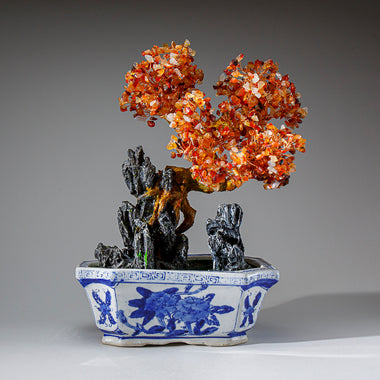
Matrix baseA natural mineral specimen used in place of a pot, so the tree appears to grow out of rock. Every matrix base is a one off, because the specimen underneath is.
Canopy spreadThe widest measurement across the branches, normally greater than the height. Spread decides whether a tree fits a shelf, and it is the figure buyers most often forget to check.
Bonsai Form or Willow Form
Bonsai formupward, structured, architectural
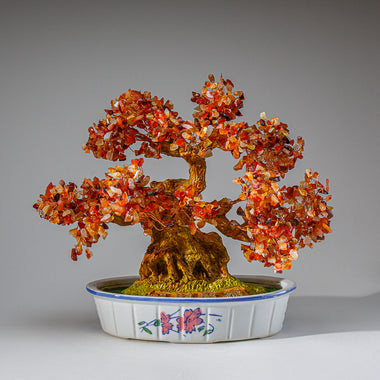
Branches leave the trunk and turn upward, ending above the point where they started. The canopy sits as a rounded mass over a visible trunk, so the silhouette reads as a miniature tree rather than a spray of stone.
- Trunk stays visible, which shows the wire work
- Holds its shape well and dusts easily
- Reads clearly from across a room
- Usually paired with an oval or round ceramic pot
Willow formfalling, flowing, softer outline
Branches arch out and drop, with tips finishing below the point where they leave the trunk. The result is a curtain of stone that catches light along its length, and it is frequently set on a mineral base rather than in a pot.
- Softer, more organic silhouette
- Wider canopy spread for the same height
- Shows chip colour better, since more chips face outward
- Tips need clearance, or they compress against a wall
The Stones, the Pots and the Mineral Bases
What is on the grid, and what each choice changes
Three stones and three base types account for the whole range. Stone decides colour and light behaviour; the base decides weight, footprint and whether the piece reads as decorative or as a specimen.
- Amethyst
- The purple variety of quartz, Mohs 7, and by a wide margin the most requested stone for trees. The colour question gets its own treatment on the dedicated amethyst tree page rather than here.
- Carnelian
- A translucent orange to deep red variety of chalcedony, the microcrystalline form of quartz, coloured by iron oxide. Mohs 7. Carnelian chips glow when backlit, so these trees perform best near a lamp or a window.
- Garnet
- Not one mineral but a group of silicates sharing a crystal structure, typically deep red almandine in chip form and at Mohs 7 to 7.5 the hardest stone used here. Garnet reads as a dense mass rather than a sparkle.
- Ceramic pot, oval
- The wider footprint, used under taller and more spreading canopies because an oval gives the tree a long axis to balance across. Standard on the fifteen inch bonsai trees.
- Ceramic pot, round
- The compact option and the usual seat for a nine inch tree. Small footprint, easy to place on a narrow shelf or a desk beside a lamp.
- Mineral base
- A specimen used as the ground. A fluorite base brings colour zoning and translucency but is soft at Mohs 4 and cleaves four ways, so it wants a stable shelf. An amethyst matrix base is a geode section: heavier, tougher, and two collectables in one object.
Chip Quality Is Where the Money Goes
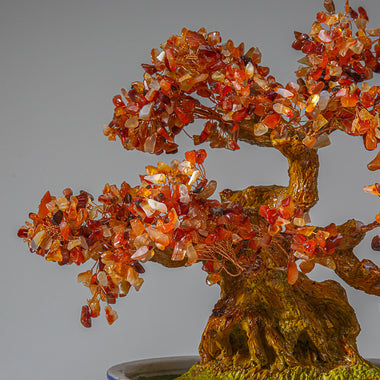
Two trees of the same height, stone and form can sit a hundred dollars apart, and almost all of that gap is in the chips. Chip count comes first, because a dense canopy needs several hundred pieces and each is threaded by hand. Chip size grading comes second: a maker who runs larger chips near the trunk and smaller ones at the tips produces a tapered, believable canopy, while ungraded chips give a blunt outline that never resolves. Translucency is third and the most visible of all, since chips cut from clean material glow at the edges while chips cut from cloudy offcuts read as opaque gravel from two feet away.
Finish matters as much as material. Well tumbled chips have rounded edges and a consistent gloss across the whole canopy, while rushed ones show flat sawn faces and chalky patches that catch dust. Hold a listing photograph up and look at the outer edge of the canopy against the background: that silhouette says more about grading and density than any close view of the trunk.
You are buying labour as much as stone. Chips are cheap by weight; the hours spent threading and twisting them are not, and that is the real difference between two trees that look alike.
Nine, Twelve and Fifteen Inches: What Each Height Does
9 inchesDesk, bedside, narrow shelf
12 inchesConsole, mantel, sideboard
15 inchesStatement piece on an open surface
SpreadUsually wider than the tree is tall
Height on these listings is measured from the bottom of the pot or base to the highest branch tip, so it includes the seat as well as the tree. The figure that catches people out is canopy spread, which on a willow form often exceeds the height: a twelve inch willow can occupy a fourteen inch circle, and a shelf that fits the height perfectly will still crush the tips against the back wall. Allow a hand's width of clearance on every side.
Nine inches is the gift tier and the desk tier at once, with a small footprint and a low centre of gravity. Twelve inches reads as a proper object rather than an ornament, and it is where most of this collection sits. Fifteen inches wants an open surface and light from at least one side. Above that the honest answer is a cluster tree on a mineral base, where the weight of the base is what makes the height stable.
What Separates a Well Made Tree From a Cheap One
Canopy density and gradingLook at the silhouette, not the centre. A good canopy is opaque at its core and tapers to individual chips at the edge. A thin one shows daylight through the middle and reveals bare wire, which no amount of arranging will hide on your shelf.
Branch constructionBranches should divide at least twice between trunk and tip, the way a real one does. Single strands with chips strung along their length are quick to make and look it. Count the junctions in the listing photographs.
The joint at the baseThe trunk should enter the pot or base cleanly, filler level, with no adhesive pooled at the surface. Set the piece on a flat surface and it should stand without rocking, because that joint carries every ounce of the tree.
ProportionRoughly a third of the visible height should be trunk and two thirds canopy, with the canopy centred over the base rather than leaning off one side. Trees that fail this look wrong immediately, even to people who cannot say why.
Wire disciplineNo bare kinks, no sudden gauge change mid branch, and tips finished so chips cannot slide off. Exposed wire at the tips is the commonest defect in mass produced trees and it worsens every time the piece is dusted.
Which Tree to Buy First
The first treegift scale, easy to placeA nine inch bonsai in a round ceramic pot. Small enough for any surface, robust enough to post, and priced alongside the rest of the entry level range in gifts and polished hearts.
The warm roomcolour that works with lamplightCarnelian at twelve or fifteen inches. Orange chalcedony against a warm bulb is the best light performance in the range, and it sits comfortably with wood, brass and the honey banding of agate.
The specimen buyera tree that is also a mineralA willow tree on a mineral base. You get a wire sculpture and a genuine specimen in one object, and the base can be judged on its own merits alongside the mineral collection. Garnet on fluorite is the classic pairing.
The commissionone piece, built to a briefA custom designed clustered tree standing on an amethyst matrix, at the top of this collection and of the amethyst tree range. Ask before ordering, because what can be built depends on the base material available.
What These Trees Cost, From Pot to Commission
Six trees from across the range, shown as a sample rather than as the full spread of what is in stock. Each row links to its live listing, where the current price, the exact height and the photographs of that individual tree are shown. Prices were verified against the live listings on 17 August 2026.
Compare the whole range side by sideEvery tree shows its own height, stone, base and live price. Ask for extra angles on any listing and a specialist will photograph the canopy and the base joint before you decide.
Shop all gemstone trees
Amethyst trees
Care, Reshaping and Keeping the Wire Tight
Dust is the only routine maintenance a gemstone tree needs, and the method matters. A cloth snags on chip edges and pulls branchlets out of position, so use a soft dry brush or a puff of air from a blower instead, working from the trunk outward. Never immerse a tree: water reaches the filler holding the trunk in its pot and tarnishes the wire in a way no polish reverses.
Reshaping is expected rather than risky, because annealed wire is built to be moved. Take hold of a branch at its base and move the whole group, never at the tips, where the strain lands on the last chip and the wire holding it. Keep the tree out of long direct sunlight, since amethyst and carnelian are both iron coloured quartz and months of hard daylight will pale them. A fluorite base wants the same protection plus a stable position, because at Mohs 4 it cleaves cleanly in four directions and a knock against a shelf edge takes a flake off. Always lift a tree by the pot or the base, never by the trunk and never by the canopy.
Packing a Tree So It Arrives With Its Shape
Branches are the fragile part, not the stone. A tree is packed by immobilising the canopy first so the branches cannot swing, then securing the heavy base independently, because an unsecured base becomes a hammer inside its own box. The whole assembly is double boxed with the void filled so the inner carton floats. Astro Gallery of Gems ships tracked and insured worldwide, and the same team that catalogues the collection at 417 Fifth Avenue does the packing, which is the reason wire sculpture travels at all.
On arrival, cut the outer carton away rather than tipping the tree out, lift the piece by its base, and expect the canopy to look slightly compressed. That is normal and it is what the packing is for. Open the branches back out with your fingers from the junctions and the tree returns to the shape in the photographs within a minute. Report transit damage by the next business day so the claim can be raised at once. Returns run on a fourteen day window from delivery, repacked as it arrived, with the full terms on the shipping and returns page.
Straight Answers to the Questions We Get Most
What is a gemstone tree?
A hand assembled sculpture in which hundreds of small polished stone chips are threaded onto fine wire, twisted into branches, gathered into a trunk and seated in a ceramic pot or on a natural mineral base. Nothing is moulded or cast, which is why no two come out identical.
Are the stones on these trees real?
Yes. The chips are genuine polished mineral, amethyst, carnelian and garnet across this collection, and the mineral bases are real specimens rather than composite. The armature is metal wire and the pots are ceramic, as the listings state, and any repair or stabilisation is disclosed rather than left for you to discover.
How is a gemstone tree made?
From the leaf inward. Chips are graded and threaded onto annealed wire, three to six strands are twisted into a branchlet, branchlets are twisted into branches, and all the branch wires are gathered and bound into a trunk. The wire ends are then splayed into roots and set into a pot or across a mineral base, and the canopy is opened out by hand until the tree stands square.
What height should I choose?
Nine inches for a desk, a bedside table or a gift. Twelve inches for a console, a mantel or a sideboard, which is where most of this collection sits. Fifteen inches for an open surface where it can be the main object. Check canopy spread as well as height, because a willow form is often wider than it is tall and needs clearance on every side.
Why do two similar trees have different prices?
Almost always the chips and the hours. Chip count, size grading from trunk to tip, translucency and polish quality decide how a canopy reads, and a denser, better graded canopy takes far longer to assemble. Base material is the other factor, since a natural mineral base is a specimen in its own right while a ceramic pot is not.
Which gemstone tree should I buy first?
A nine or twelve inch bonsai in a ceramic pot. It is the easiest to place, the easiest to ship and the cheapest way to find out how much canopy density you actually care about. Buyers who want a specimen as well as a sculpture should go straight to a willow tree on a mineral base instead.
Can a gemstone tree be made to order?
Commissioned trees do exist in this range, and the top piece here is a custom designed clustered tree built onto an amethyst matrix base. Whether a specific combination of stone, height and base can be built depends on the base material on hand at the time, so ask before ordering rather than assuming.
How do I clean and reshape one?
Dust with a soft dry brush or a puff of air, working from the trunk outward, and never immerse it, because water reaches the filler holding the trunk and tarnishes the wire. To reshape, hold a branch at its base and move the whole group rather than pulling on the tips. Keep it out of long direct sunlight, since amethyst and carnelian are iron coloured quartz and can pale.
How is a gemstone tree packed and shipped?
The canopy is immobilised first so the branches cannot swing, the heavy base is secured separately, and the whole assembly is double boxed with the void filled so the inner carton floats. Everything travels tracked and insured worldwide. On arrival, lift the tree by its base, open the branches back out from the junctions, and report any transit damage by the next business day.
Rated everywhere we trade
Not sure which stone or which height?Tell us the surface, the light in the room and who it is for. A specialist at Astro Gallery of Gems will shortlist trees and photograph the canopy and base joint from the angles the listings do not show.
Ask a specialist
(212) 889-9000