Skip to content

Meteorites in Display Cases

Iron, stony and pallasite fragments seated behind glass, every case carrying a printed card that names the fall, the recovery year and the classification.

Meteorites in Display Cases Priced Complete With the Box, the Mount and the Locality Card

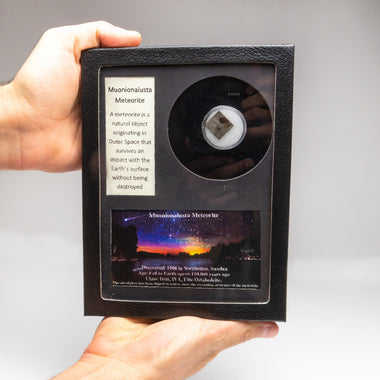
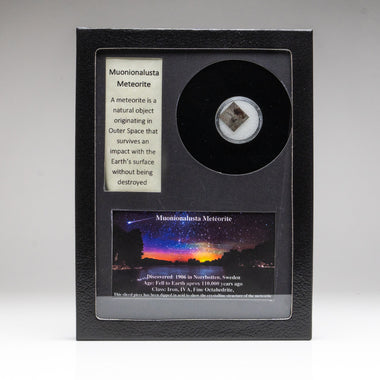
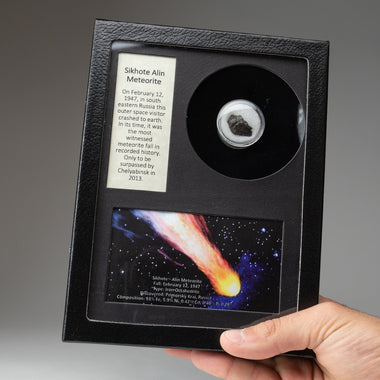
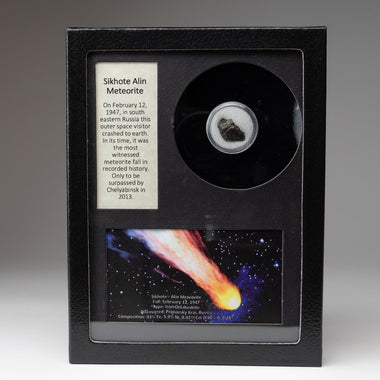
A meteorite in a display case is an authenticated fragment seated in a glass fronted box of roughly six by eight inches. A printed card sits beside it, naming the fall, the recovery year and the class the piece was catalogued under. Astro Gallery of Gems buys this material from recovery teams and at the Tucson, Denver and Munich shows. The gallery then weighs and grades each fragment in the New York workroom and seats it in its case before the price on the listing goes live. All 6 cased meteorites here ship as a finished object rather than a bare shard in a bag.

Why Does the Case Belong to the Purchase?

A loose meteorite fragment loses most of its meaning the moment it leaves the dealer. The classification, the strewn field and the recovery year live in paperwork rather than in the metal itself. A glass fronted case keeps that information physically attached to the specimen for as long as the two stay together. Astro Gallery of Gems mounts and labels these fragments for exactly that reason, instead of bagging them by weight.

The cased fragment as a finished objectA boxed Sikhote-Alin or Muonionalusta fragment arrives ready to stand on a desk, a classroom shelf or a night stand, with the locality card doing the explaining. Buyers take this path when the piece is a gift and nobody wants to hunt afterwards for a stand, a label or a case that fits.
The loose specimen for a working cabinetCollectors building a systematic cabinet want larger etched slices and whole individuals they can weigh, turn and relabel to their own numbering scheme. That material sits in the wider meteorite collection, sold by gram weight with no case in the price.

Which Falls and Finds Sit Inside These Cases?

Each case is titled by the fall it came from rather than by a generic label, because provenance is the substance of what a meteorite buyer pays for. Astro Gallery catalogues every fragment under its formal classified name, and that name travels on the card, on the itemised invoice and in the listing title.

Sikhote-Alin, Primorsky KraiSikhote-Alin fell across the Russian Far East in February 1947 and delivered an estimated seventy tonnes of coarsest octahedrite iron, class IIB. Fragments are shrapnel torn rather than sawn, so the cased pieces show ragged edges and ablation hollows that read clearly through the glass.
Muonionalusta, NorrbottenMuonionalusta is a fine octahedrite of class IVA that reached northern Sweden roughly a million years ago and lay under glacial till until 1906. Its nickel iron etches into a tight crossed band structure, which makes it the most legible small fragment in this group.
Agoudal, High Atlas MountainsAgoudal iron was collected in the High Atlas of Morocco from 2000 onward and classified IIAB hexahedrite, a low nickel structure that stays scarce among irons. Cased Agoudal fragments run near three quarters of an inch, a scale that suits a desk rather than a shelf.
Sericho and Brenham pallasitesSericho came out of Isiolo County in Kenya in 2016 and Brenham out of Kansas in 1881, both holding rounded olivine at Mohs 6.5 in a nickel iron matrix near Mohs 4. Astro Gallery seats these slices upright so window light passes through the green and orange crystal.

What Do the Cases and the Fragments Actually Measure?

Case dimensions decide whether a piece works on a desk, inside a cabinet or in the hands of a child carrying it to school, so every listing states them. Astro Gallery measures the outer box as well as the specimen, which lets shelf planning happen before anything reaches the cart.

FormatDimensions, contents and where it works
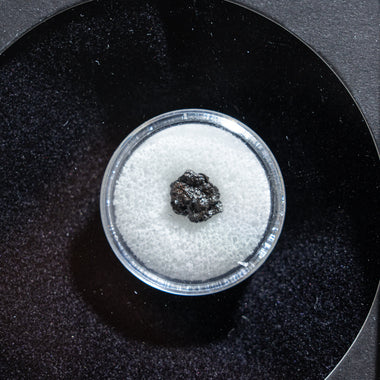
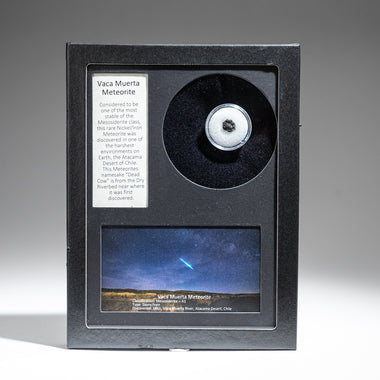
Glass topped card caseAbout six by one by eight inches, holding a fragment near three quarters of an inch beside a colour image of the fall, and lying flat on a desk.
Deep tray caseAbout eight by six and a half by three quarters of an inch, cut for Sikhote-Alin and Chelyabinsk material whose relief needs seating depth clear of the glass.
Upright slice caseAround six and a quarter by eight and a quarter inches, built to stand a thin Sericho or Brenham pallasite slice where daylight reaches the olivine.
Fragment scaleCased specimens span three quarters of an inch to a little over an inch, while the heavier stony pieces from Niger and Chile reach roughly two hundred and fifty grams.
Gross shipping weightOne to three pounds once case, cut foam and outer carton are counted, which is the figure any freight quote is calculated against.

What Does Each Cased Meteorite Cost Today?

Every row below is a live listing rather than a printed range, so the price on the listing is the figure charged at secure checkout. A case that sells leaves this table rather than lingering as something you cannot add to cart.

PieceDetailPrice
Genuine Agoudal Meteorite in Display Box See listing $ 89.00
Genuine Muonionalusta Meteorite in Glass Display Box See listing $ 89.00
Genuine Sikhote-Alin Meteorite from Russia in Glass Display Box See listing $ 69.00
Genuine Chelyabinsk Meteorite In Glass Display Box See listing $ 75.00
Genuine Sericho Meteorite in Glass Display Box See listing $ 99.00
Genuine Vaca Muerta Meteorite in Glass Display Box See listing $ 89.00

Rated everywhere we trade

Photographs of the actual case before you commitAstro Gallery photographs the box, the card and the fragment on request, usually within the same working day.
View all 6 pieces Request photographs

What Should You Check Before Adding a Case to the Cart?

Four things separate a properly built cased meteorite from a souvenir, and each shows in the listing photographs or the written description rather than needing the piece in hand.

The classified name on the cardA card reading Sikhote-Alin IIB or Muonionalusta IVA names a formally classified meteorite, while a card reading only iron meteorite names nothing. Astro Gallery prints the fall, the country and the class on every card it issues.
Stock photograph or exact specimenListings for Agoudal, Sericho, Vaca Muerta and the Niger chondrites state plainly that a stock photograph stands in and a fragment of matching class and weight ships. Larger single specimens are one of one and photographed individually.
Seating and glass clearanceThe fragment should rest in its recess without touching the lid, since a shard held under tension cracks the glass in transit. Astro Gallery reseats any specimen that shifts when the case is tilted.
Existing rust and terrestrial weatheringSikhote-Alin and Agoudal are finds rather than observed falls, so orange pitting belongs to their condition rather than counting as damage. Astro Gallery grades that weathering and records it in the description.

How Do You Read the Card Inside the Case?

HexahedriteAn iron meteorite low enough in nickel to have crystallised as a single kamacite structure, which is the class Agoudal material was assigned.
Fine octahedriteAn iron whose kamacite bands measure well under a millimetre, giving Muonionalusta its tight crosshatch once a face has been sawn and etched.
Pallasite PMGA stony iron carrying olivine inside a nickel iron matrix, with the main group tag that covers both Brenham and Sericho material.
SuperbolideA fireball brighter at entry than the sun, the term the Chelyabinsk card uses for the event of 15 February 2013 over the southern Urals.
Impact melt brecciaRock shattered and partly melted by a collision in space, then welded together again, which is how the Tassedet 004 fragment from Agadez is described.
Carbonaceous chondriteA stony class holding carbon compounds and calcium aluminium inclusions, represented in these cases by a CV3 from Niger catalogued as NWA 12322.

Does Humidity Reach the Meteorite Through the Case?

Glass slows moisture exchange without stopping it, so a cased iron still wants dry air around it, and condensation forms on nickel iron long before it forms on the glass. Astro Gallery stores these boxes away from bathrooms, kitchens and cold exterior walls, and the same rule applies on a shelf at home. Slip a silica gel sachet behind the mount and replace it yearly, and keep the box off a radiator ledge where air cycles between damp and hot. Lift the case by its edges so skin salts never reach the specimen. Pallasite slices and stony chondrites carry far less free metal and tolerate ordinary room conditions.

Who Buys a Cased Meteorite, and Where Does It Stand?

Two audiences buy this format and one printed card serves both. Gift buyers want an object that explains itself on a desk or under a tree. A boxed Muonionalusta fragment does exactly that, with no plinth, stand or handwritten label required. Teachers and parents choose the stony chondrites and the Chelyabinsk shards for the same reason, since the card carries the date and the entry speed. Metaphysical buyers approach meteorite iron through the vocabulary of grounding and cosmic connection. Astro Gallery names that vocabulary honestly while documenting only class, locality and weight, and makes no health or energetic claim about any fragment.

How Does a Cased Meteorite Reach You?

Astro Gallery of Gems has priced, invoiced and shipped natural history from its New York rooms since 1961, and a cased fragment moves through the same steps as a cabinet specimen. The price on the listing is the figure charged, and secure checkout settles through Shop Pay, PayPal, Apple Pay, Google Pay, Visa or Mastercard. The itemised invoice names the fall, the class and the case rather than a single generic line. A piece marked in stock is a piece already boxed, carded and sitting on the shelf.

Astro Gallery packs each case by hand, tapes the lid closed and floats the box in cut foam so the glass never meets a carton wall. Anything travelling beyond the United States is double boxed. Every parcel leaves tracked and fully insured for its declared value, with customs paperwork completed before dispatch. Astro Gallery quotes freight in advance when several cases travel as one consignment. The returns policy covers a case that arrives other than as described, and the guarantee published on about us applies to the classification printed on the card.

Ordering several cases togetherAstro Gallery groups multiple cases into one insured carton and confirms the freight figure with you before the order is placed.
Browse the cased meteorites Email the gallery

What Do Buyers Ask Before Ordering a Cased Meteorite?

How much does a meteorite in a display case cost?
Cased meteorites occupy the entry tier of the meteorite catalogue, well below etched slices and whole individuals sold by gram weight. The table above carries live prices for everything currently in stock, and each figure covers the fragment, the case, the mount and the printed card together.
Is the meteorite inside the box genuine?
Yes. Every fragment is a classified meteorite catalogued under its fall name, and Astro Gallery buys direct from recovery teams and at the Tucson, Denver and Munich shows. Smelting slag and cast iron imitations carry no kamacite structure and no classification, which is why the class appears on each card.
Will I receive the exact fragment shown in the photograph?
That depends on the listing, and each one says which. Larger single specimens are one of one and photographed individually, while the Agoudal, Sericho and Niger chondrite listings state that a stock photograph stands in and a comparable fragment of the same class and weight ships instead.
How big is the display case?
Most cases measure about six by eight inches with a depth near one inch, while the deeper tray format runs closer to eight by six and a half inches. The fragment inside usually spans three quarters of an inch to a little over an inch, and every listing gives the box dimensions.
Will an iron meteorite rust inside a sealed case?
Nickel iron corrodes wherever damp air reaches it, and a display case slows that exchange rather than preventing it. Keep the box in dry air, add a silica gel sachet behind the mount, and handle the case by its edges. Pallasite slices and stony chondrites hold far less free metal.
Can I open the case and hold the meteorite?
Yes, the lids lift away. Astro Gallery reseats the fragment in its recess before packing, so closing the case again takes a moment, and handling the piece with a cloth keeps skin salts off the iron. Anyone planning to handle a specimen daily is better served by a loose piece.
Do you ship cased meteorites internationally?
Yes. Every case leaves tracked and fully insured for its declared value with customs paperwork completed before dispatch, and Astro Gallery quotes freight in advance when several cases travel together. Meteorite material enters most destinations freely, and the gallery confirms any restriction before an order moves.
Can I return a cased meteorite if it does not suit the recipient?
Yes, under the returns policy published on the site. Keep the case, the card and the outer carton, contact customer service inside the stated window, and Astro Gallery arranges the exchange or the refund against the itemised invoice.

Where Do These Cases Sit in the Wider Catalogue?

Cased fragments open the meteorite category, and buyers move in two directions from here. Some want the same falls in larger uncased form, sold by gram weight and ready for a cabinet. Others want the boxed display format applied to fossils, minerals and gifts at a similar price.

Natural history in the same room
Boxed and mounted display
Gifts at this price level