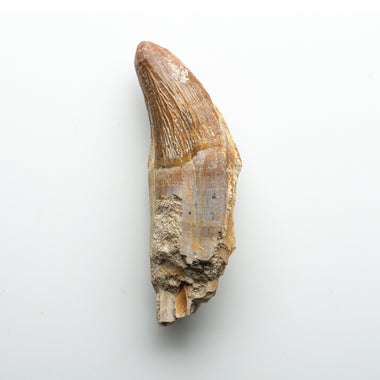
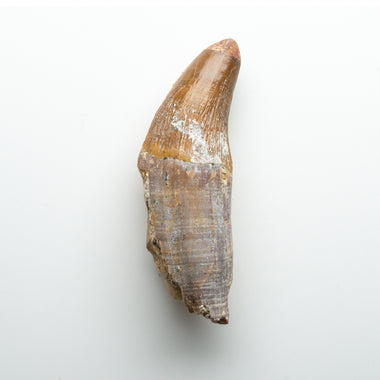
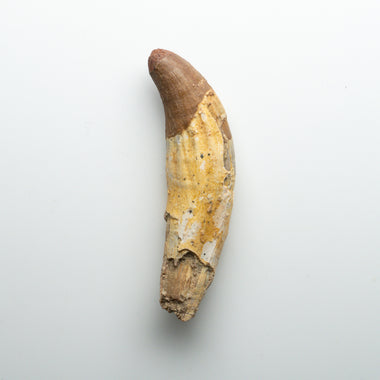
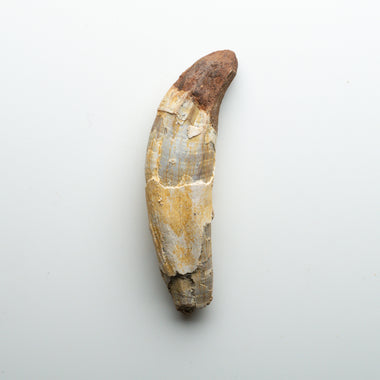
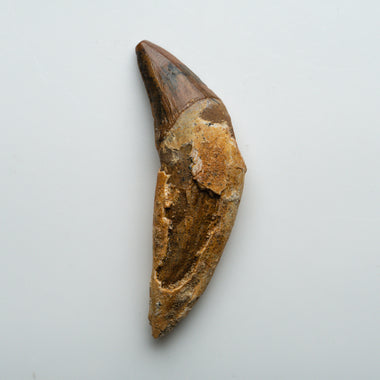
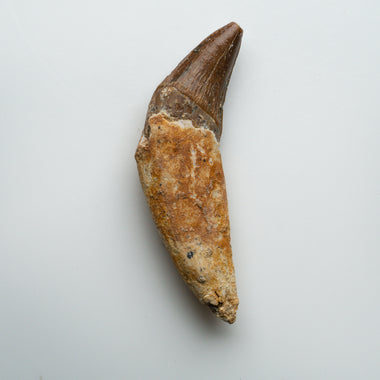
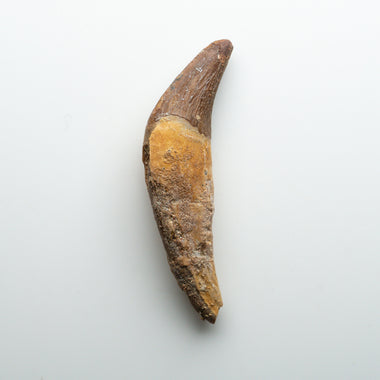
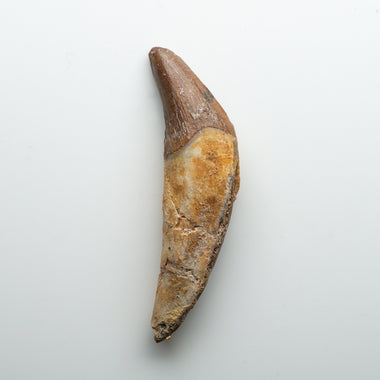
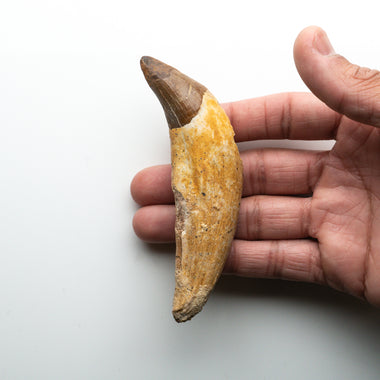
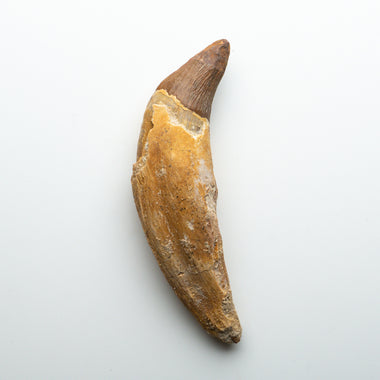
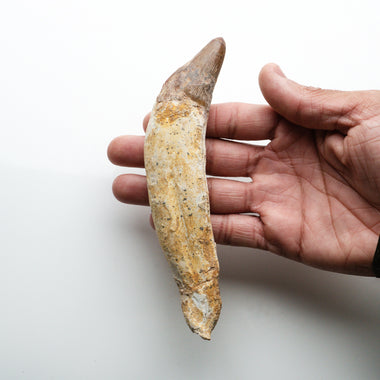
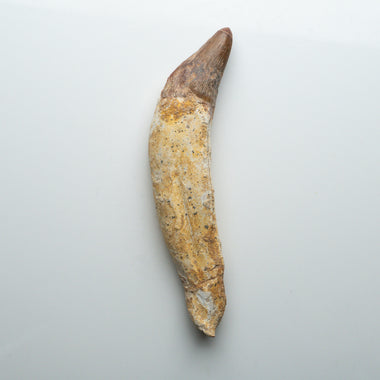
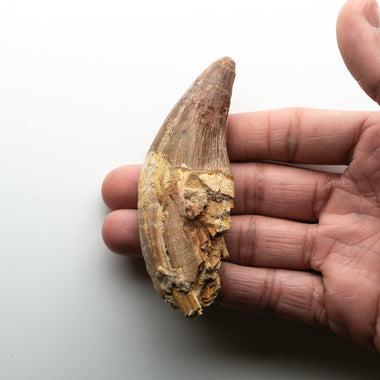
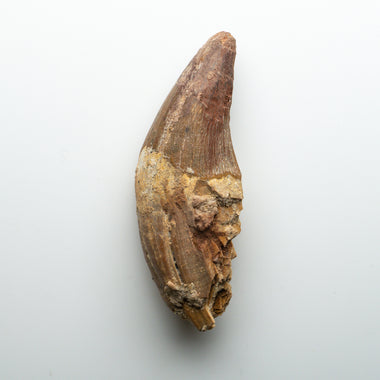
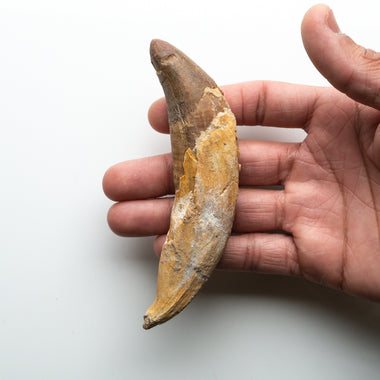
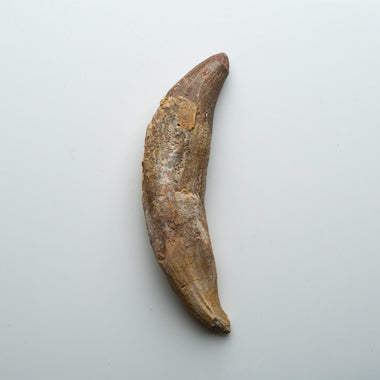
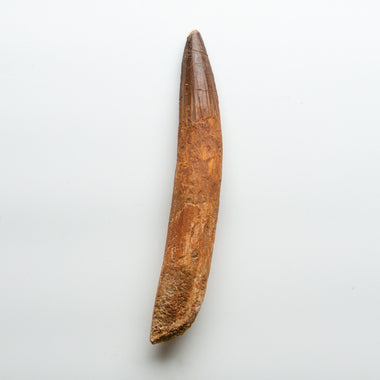
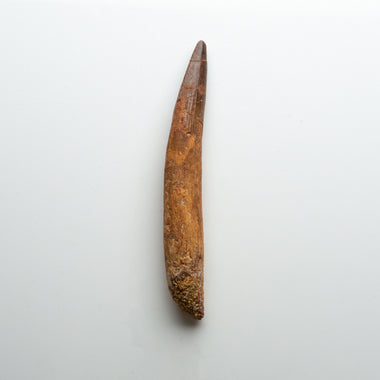
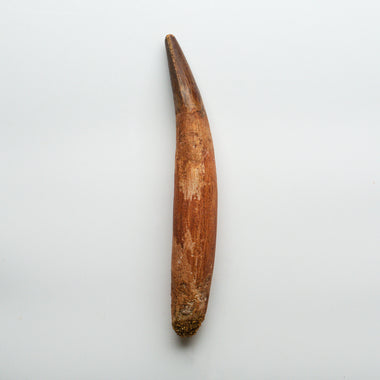
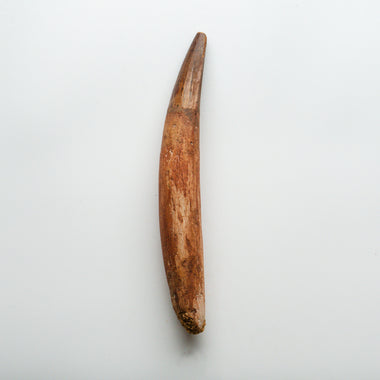
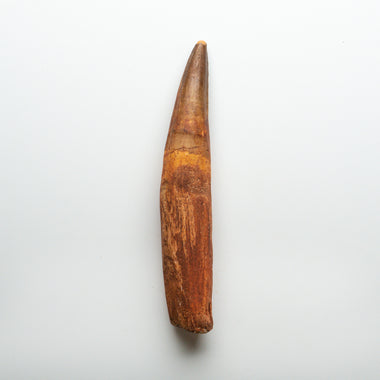
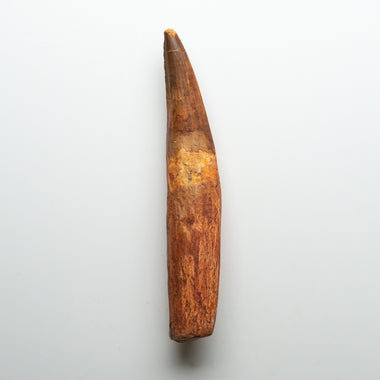
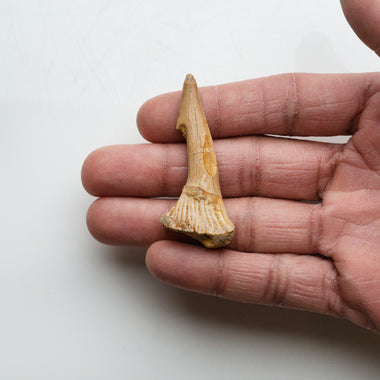
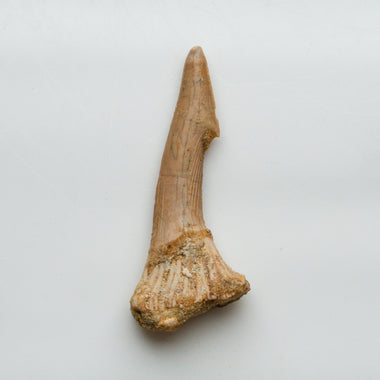
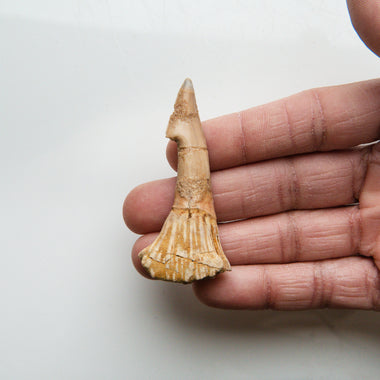
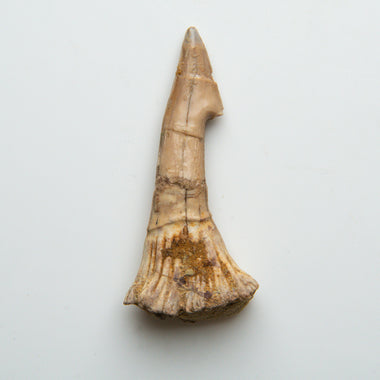
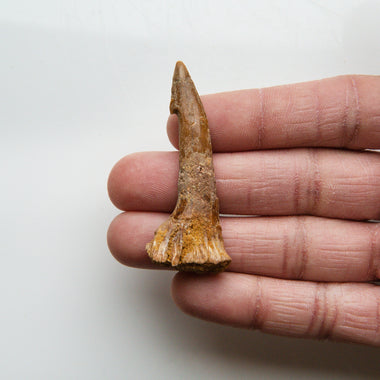
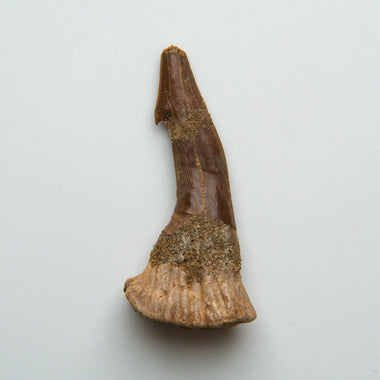
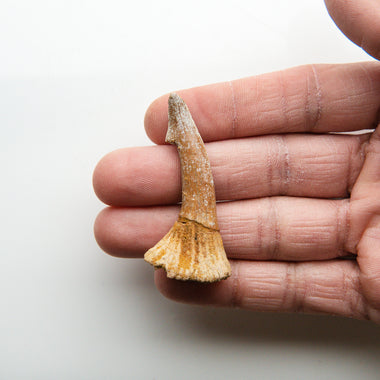
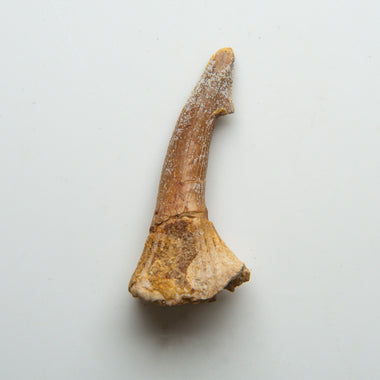
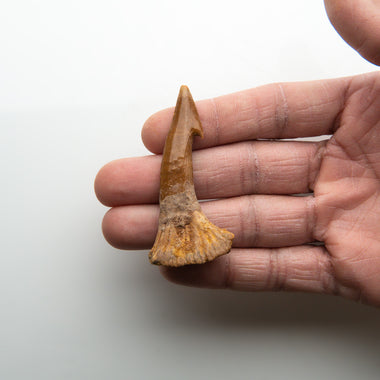
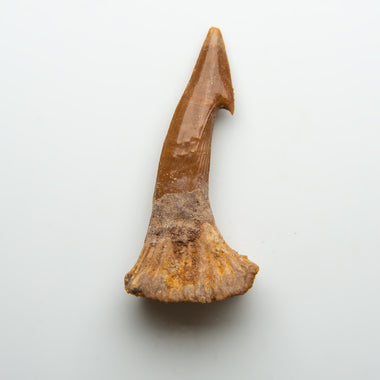
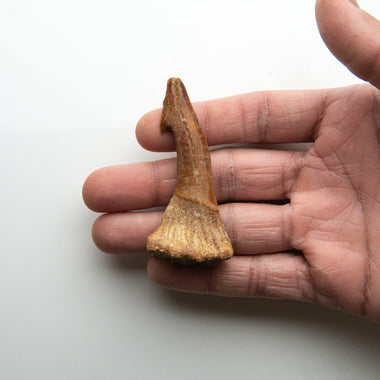
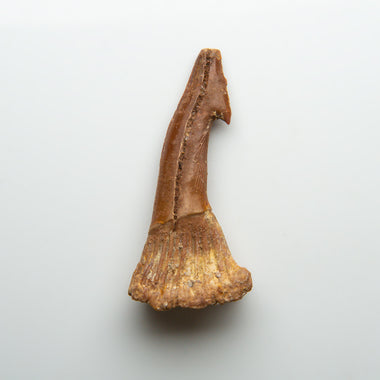
Spinosaurus cones from the Kem Kem, serrated Carcharodontosaurus blades, Mosasaurus jaws from Khouribga and Eocene whale teeth.
Genuine Fossil Teeth from Spinosaurus, Carcharodontosaurus, Mosasaurus and Basilosaurus, Measured and Weighed Individually
A fossil tooth is a permineralised crown, sometimes still joined to its root or sitting in a block of jaw, whose value rests on the species, the enamel surface and the honesty of the repair record rather than on age alone. Astro Gallery of Gems weighs every tooth in grams, measures it in inches and photographs it against a plain ground once it has been bought out of the Moroccan phosphate and sandstone workings, so the 87 teeth catalogued here can be compared species against species before anybody spends anything.
Start With the Species and the Formation It Was Collected From
Species and formation come before size, colour or price, because they explain the shape in front of you. A cone with no serrations and a blade with fine denticles down both edges came out of the same North African beds and belonged to two entirely different animals, and Astro Gallery names the species on every listing.
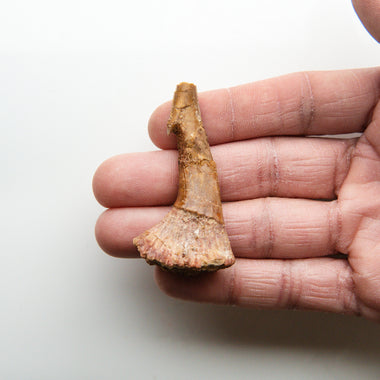
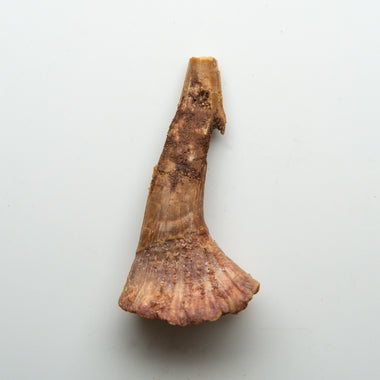
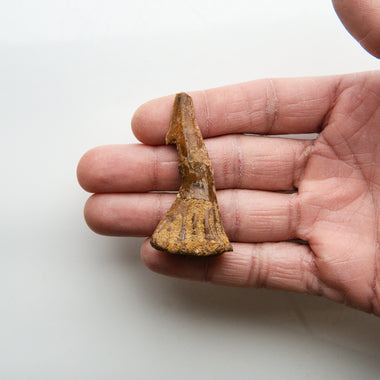
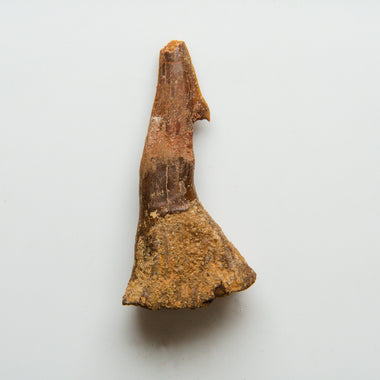
Spinosaurus, Kem Kem beds of MoroccoA theropod of the upper Albian to upper Turonian, roughly 112 to 93.5 million years old, first described by Ernst Stromer in 1915. Its teeth are round in cross section, finely fluted and unserrated, which makes them the easiest species here to identify.
Carcharodontosaurus, Tegana FormationThe same North African Cretaceous sequence yields these laterally flattened blades, recurved and carrying denticles along both cutting edges. Enamel runs dark chocolate to grey, and complete tips command a clear premium over broken ones.
Mosasaurus beaugei, Oulad Abdoun BasinThe phosphate deposits at Khouribga produce this marine reptile, the largest mosasaur identified from the basin, whose faceted prismatic enamel and stout crowns often arrive still embedded in a block of jaw with several teeth in place.
Basilosaurus, Late Eocene sedimentsAn early whale of 40 to 34 million years, originally mistaken for a reptile, which is how it acquired a lizard name. Its teeth are heavy, deeply rooted and quite unlike anything in the Cretaceous material alongside them.
Match a Fossil Tooth Length to the Way You Intend to Show It
Length decides the display before the species does, and every listing here gives weight in grams followed by three dimensions in inches, with the largest of the three being the tooth measured tip to base in a straight line rather than around the curve. These four bands cover the current shelf.
| Band | What falls into it and where it goes |
| Under three inches, 15 to 25 grams | Small Spinosaurus cones and Mosasaurus crowns on matrix, light enough for a desk, a labelled box or a first fossil bought for a child. |
| Three to four inches, 25 to 50 grams | The main run of Spinosaurus and Carcharodontosaurus crowns, the band where enamel quality rather than size sets the price, and the easiest to stand on a small riser. |
| Four to six inches, 80 to 150 grams | Large Spinosaurus crowns and heavy rooted Basilosaurus whale teeth, which need a proper stand, a lit shelf and clear space around them to read. |
| Jaw sections, one to two pounds | Mosasaurus beaugei jaw blocks from the Khouribga phosphate carrying several teeth in place, horizontal pieces that want shelf depth rather than height. |
Check the Enamel, the Root and the Repair Before You Pay
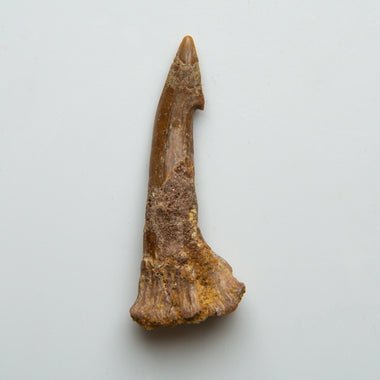
Four things separate a good fossil tooth from an ordinary one, and all four read from photographs taken at the right angle. Astro Gallery shoots each tooth from several sides for exactly this reason, so nothing important sits on the face nobody photographed.
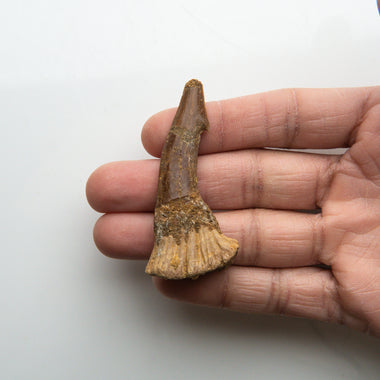
Enamel surface and glossOriginal enamel holds a glassy sheen and shows fine flutes or denticles under raking light, while a heavily worked tooth reads flat and uniform. Hairline stress cracks are normal in a fossil and are not the same as a break.
Root present or crown onlyMost Kem Kem teeth were shed in life and arrive as crowns without roots, which is why a tooth retaining its root, or one still set in jaw bone, sits at a higher level than a bare crown of the same length.
Repair against restorationRepair rejoins genuine fragments of one tooth, while restoration fills a gap with modelled material, and a composite marries pieces of different teeth. Astro Gallery states which applies to any tooth that carries such work.
Preparation and matrixAir scribe tracks around a crown show where the preparator freed it from rock, and a consolidant is often brushed on to hold fragile enamel. Both are ordinary practice, and both belong in the description.
Compare Current Fossil Tooth Prices Piece by Piece
Astro Gallery prices each tooth against its own species, length and enamel condition, so the figures below track the catalogue rather than a fixed sheet. Every row is one physical specimen, and a tooth that sells drops out of the table instead of sitting here as something you cannot order.
Species, weight and length stated on every toothEach listing names the animal and the beds it came from, gives the weight in grams and the length in inches, and updates its price live.
View all 87 pieces
Request extra angles
Rated everywhere we trade
Choose Between a Boxed Display Tooth and a Collector Specimen
This collection runs on two tracks that suit different buyers, and the difference is stated plainly on each listing rather than buried in the small print.
The boxed display toothA genuine tooth arrives in a glass topped box carrying a printed label, a colour photograph and a few lines about the animal, ready to hand over as a gift or take into a classroom. These are supplied as representative examples of a grade, so the tooth you receive matches the photograph closely without being that identical specimen.
The individually catalogued specimenLarger crowns, rooted teeth and jaw blocks are photographed one at a time and sold as single objects, with the weight, the three measurements and any repair written into the description. Collectors buy on this track because the enamel in the images is the enamel that arrives.
Learn the Words a Fossil Tooth Description Uses
CrownThe enamel covered part of the tooth that stood above the gum line, and the portion quoted whenever a description gives a crown height rather than a total length.
RootThe dentine anchor that sat inside the jaw, absent from teeth shed during life and present on teeth lost after death or collected still in bone.
DenticleOne of the small saw teeth along the cutting edge of a blade shaped crown, present on Carcharodontosaurus and absent from the conical Spinosaurus teeth.
FluteA fine vertical ridge running down the enamel of a spinosaurid tooth, visible under raking light and worn smooth on beach rolled or heavily polished material.
MatrixThe sediment the fossil sits in, phosphate or sandstone in this material, left in place when it supports the piece and removed with an air scribe when it hides it.
CompositeA tooth assembled from fragments of more than one specimen, which is a different thing from a repair and is always named as such in a description.
See How a Fossil Tooth Is Packed, Insured and Delivered
Checkout takes Google Pay, Apple Pay, PayPal and Shop Pay as readily as Discover, Diners Club, Visa and Mastercard, and the invoice sets down the species, the beds it came from and the weight of the specimen you bought. Ask our team beforehand for the reverse of a crown, a photograph against a ruler, or a close view of a repair line, and they will send it the same day rather than referring you back to the listing.
Astro Gallery of Gems has shipped fossil material since 1961, and a tooth is packed tip first in the thinking. The point is isolated in cut foam so no pressure reaches the most fragile millimetre, boxed teeth travel inside a second carton, and jaw sections are blocked at the matrix so the specimen cannot shift against its own teeth. Nothing is dispatched without tracking, cover at the full declared value and the export documents already completed. A written guarantee on about us and the returns policy cover the tooth from the moment its invoice is issued.
Keep a Fossil Tooth Out of Water, Heat and Direct Sun
Fossil teeth are mineralised, not stone, and they respond badly to the three things people usually try. Water soaks into porous root material and into phosphate matrix, so dust with a dry soft brush and never wash a tooth or a jaw block. Direct sunlight pales dark enamel across a season, and heat from a radiator or a spotlight softens the consolidant and any adhesive holding a repair, which is how a sound tooth quietly comes apart on a shelf. Handle the specimen by the root or by the matrix rather than the tip, keep it in a stable room rather than a damp basement, and give a heavy jaw block a stand that carries its whole length.
Ask for the tooth against a rulerRequest a measured photograph, the reverse face and a close view of any repair before you decide, and our team will put them in your inbox that day.
Browse the fossil teeth
Email the gallery
Read the Answers Buyers Want Before Ordering a Fossil Tooth
Are these dinosaur teeth real fossils?
Yes, every tooth on this page is genuine fossil material collected from documented beds, not a cast or a resin copy. We name the animal and the formation on each listing, and any repair, restoration or composite work is written into the description before you buy.
How much does a Spinosaurus tooth cost?
Price rises with length, enamel quality and whether the tip is complete, so a small cone of around twenty grams sits well below a heavy crown approaching six inches. The live table above carries everything in stock today, with each figure attached to that individual tooth.
Why do most Moroccan dinosaur teeth have no root?
Theropods shed and replaced their teeth throughout life, and a shed crown separates from its root before burial. That is why bare crowns are the norm from the Kem Kem beds and why a rooted tooth, or one still set in jaw bone, costs considerably more.
Has this tooth been repaired or restored?
The description tells you, tooth by tooth. Repair rejoins genuine fragments of one specimen, restoration fills a missing area with modelled material, and a composite combines parts of different teeth, and we name whichever applies rather than letting a photograph imply the answer.
How is a fossil tooth measured?
Each listing gives the weight in grams and three dimensions in inches, and the largest figure is the tooth measured in a straight line from tip to base rather than along its curve. Crown height, quoted separately when it matters, excludes the root entirely.
Will I receive the exact tooth in the photograph?
On individually catalogued teeth, yes, because each one is photographed alone. Boxed display teeth are supplied as representative examples of a grade, which the listing states in the description, so the piece sent matches the image closely without being that same specimen.
Is a fossil tooth a good gift for a child?
A boxed fossil tooth is one of the most popular gifts we sell, and it suits that purpose because the printed label names the animal and its age. A tooth in a glass topped box survives handling far better than a bare crown with a delicate tip.
Do you ship fossil teeth abroad, and can I return one?
We send teeth to any country under tracking, covered for the declared value, with the export documents filled in ahead of collection. Returns follow the terms published on our returns page, and a set of measured photographs sent in advance settles the point for nearly every buyer.
Follow Fossil Teeth Into the Rest of the Natural History Catalogue
Teeth are the entry point into fossil collecting for most buyers, and the shelves around them divide by what the animal left behind. Collectors chasing the same species move towards bone, while buyers who came for the display object move towards meteorites and mineral specimens.
Invertebrates and organics
Gifts and younger collectors